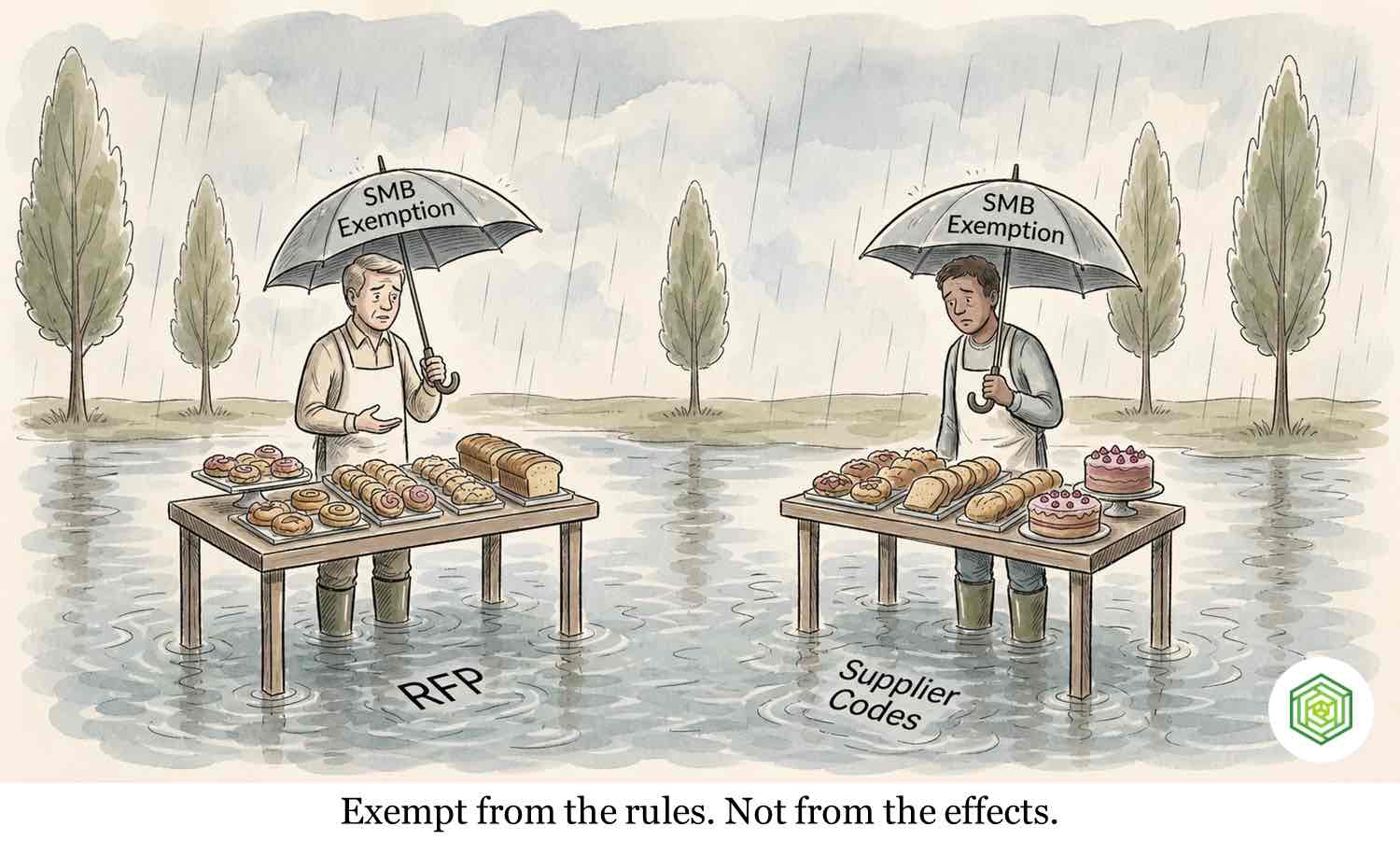
If you run a small or mid-sized business (SMB), it is easy to believe you are "too small to matter" when it comes to climate rules. On paper, you may be exempt from the main disclosure requirements. In practice, that exemption does not stop the rain. The pressure arrives through your largest customers, lenders, and partners long before it arrives as a direct regulatory requirement.
Large enterprises are being asked to measure and manage emissions across their entire value chain. That includes the thousands of SMBs that supply and support them with goods and services. This shows up when a large customer suddenly has a new "emissions" or "sustainability" tab in its supplier portal, when standard contracts add sustainability clauses, and when requests for proposals (RFPs) start asking for greenhouse gas (GHG) data. These are the downstream effects of climate rules reaching ground level.
The question is not whether those expectations will reach you. It is whether you will be ready when they do.
This article explains why exempt SMBs still get pulled into emissions reporting, using a simple idea called the "If not for you" test. It shows how that logic places most SMBs inside a much larger carbon ledger, whether they know it or not. It then walks through how that reality surfaces in supplier codes of conduct, RFPs, and one-off data requests. It also explains what a practical, reusable response looks like. If you have not read the earlier pieces in this series, you can find them in the Emerald Solutions Learning Center.
The "If Not for You" Test: Why You're in Someone Else's Carbon Ledger
To understand why exempt SMBs still end up inside their customers' climate reports, it helps to start with a simple question: If not for you, would these emissions exist? Call this the "If not for you" test.
Imagine two small bakeries at an outdoor market. Each one runs ovens, buys flour, receives deliveries, and sends customers home with bread and birthday cakes. If not for those bakeries, a long chain of activity would not happen. The farmer would not run the tractor across muddy fields to grow wheat for their orders. The mill would not use electricity to grind the wheat into flour for weekly shipments. The delivery truck would not drive the early-morning route to drop off bags at the back door. The packaging plant would not stamp out the branded boxes and wrappers that carry the bakery's name and logo. The customers would not drive across town for Saturday-morning snacks or leave with a cardboard cake box they ultimately throw away in a landfill.
All of those emissions exist because the bakeries exist. They are not coming from the bakery's own furnace or light fixtures alone. They are scattered across farms, factories, trucks, and neighborhoods. When you add them up, they live on each bakery's carbon ledger as part of its Scope 3 emissions. Scope 3 is simply everything in the value chain that would not happen if not for that business.
Now scale that logic up. Instead of a neighborhood bakery, think about a national retailer, a global manufacturer, or a large technology company. They are under growing pressure from investors, regulators, and their own boards to account for emissions across their entire value chain. Your deliveries, services, and products are part of that chain. If not for the big customer, you would not be running trucks to their facilities, producing goods to their specifications, or traveling to their sites. Those emissions now show up in their carbon ledger as Scope 3.
From their perspective, you are one of thousands of SMBs woven into the same story. They may never share the details of the rules they are responding to. What you see instead is the practical result: updated supplier expectations, new questions in RFPs, and fresh templates asking you to estimate emissions tied to your work.
You cannot control whether your emissions are part of someone else's tally. What you can control is whether you look like a black box or a prepared partner when they ask.
That is why being "exempt" does not keep you dry. Even if your own regulator never sends you a climate form, you are already in someone else's math. The "If not for you" test explains why the rain is falling on your stand in the first place, and why customers now need you to have a reliable way to count.
"If not for your business, would these emissions exist? If the answer is no, those emissions live on your customer's carbon ledger."
How Large Enterprise Climate Rules Show Up for SMBs in Practice
For most SMBs, nothing about the workday feels like climate regulation. Teams are still filling orders, managing staff, and watching margins. The changes arrive sideways, through customer paperwork and online portals, not through a notice from a regulator. In practice, that impact usually shows up in five places.
- Supplier codes of conduct: Updated language that now includes emissions-tracking expectations, often buried in documents SMBs already signed.
- RFPs and bid packages: New sustainability and emissions sections appearing in competitive bids.
- Vendor questionnaires and scorecards: Structured emissions questions sent to existing suppliers, often tied to performance reviews.
- Supplier portals: Platforms where emissions data is increasingly required alongside invoices and certifications.
- One-off data requests from key accounts: Informal but consequential asks from relationship managers and procurement contacts.
Each one feels different in the moment. Together, they add up to the same message: your largest customers need emissions data from their value chain, and you are part of that value chain.
Supplier Codes of Conduct
Many large enterprises have quietly updated their supplier expectations over the last few years. Language that used to focus on ethics, labor practices, and safety now includes lines like "suppliers are expected to track and report greenhouse gas emissions by [year]" or "we prioritize vendors with clear emissions-reduction goals." For an SMB, this often lives in a PDF they clicked "accept" on during onboarding and only surfaces later when a customer points back to it and asks, "Where are you on this?"
RFPs and Bid Packages
A bid package that once focused on price, quality, and service levels now often has a dedicated section titled "Sustainability and Emissions." The questions vary, but the themes repeat: "Do you track your Scope 1 and 2 emissions?", "Can you estimate emissions associated with this contract?", and "Do you have targets or plans to reduce emissions over time?" Even when those fields are marked "optional," SMBs quickly learn that leaving them blank is not neutral. It can make them look less prepared than a competitor who can attach a simple emissions summary and move on.
Vendor Questionnaires and Scorecards
RFPs are competitive moments. Vendor questionnaires are different. They arrive after you have already won the business. A procurement team or sustainability lead sends a structured form to existing suppliers, asking for emissions data as part of an annual review or supplier-scorecard update. The stakes feel lower because the relationship already exists. Over time, though, how you answer — or whether you answer at all — starts to influence contract renewals, preferred-vendor status, and how much business gets directed your way.
Supplier Portals
Many large buyers now manage supplier relationships through dedicated portals for invoices, certifications, and performance data. Over time, those portals sprout new tabs labeled "ESG," "Climate," or "Emissions." What starts as a one-time survey becomes an annual update request, then a required field. An SMB that could once answer "we do not track this yet" finds that the same questions keep coming back with firmer language and clearer due dates.
One-Off Data Requests from Key Accounts
A relationship manager or procurement contact reaches out with what sounds like a small favor: "We are updating our climate disclosures. Can you share your annual energy use, travel data, or any emissions estimates you have?" The template attached might only be a few lines long. Finding and filling those lines can easily consume hours of digging through invoices, utility bills, and internal emails if there is no standard way to count.
These changes do not happen by accident. Your largest customers are updating their forms because they have to explain their own carbon ledger to investors, regulators, and boards. New climate disclosure requirements from securities regulators, detailed reporting expectations for companies operating or listed in Europe, and state laws such as California's climate disclosure rules (with similar proposals emerging in other states) are all pushing large enterprises to account for emissions across their entire value chain. The simplest path for them is to ask the suppliers they rely on most for clearer, more consistent information. Whether you are ready to provide that emissions data is increasingly the question on the table.
"Climate rules show up for SMBs not in the mail from regulators, but in supplier codes, RFPs, questionnaires, portals, and 'quick' data requests."
The Cost of Answering from Scratch Every Time
At first, each new request can feel like a one-off annoyance. A few extra questions in an RFP. A short email from a key account. A new tab in a portal you already use. It is tempting to treat each one as a small exception and move on. The trouble is that these "exceptions" add up fast.
Every large customer tends to use a different format. One wants total emissions by scope. Another wants energy use by site. A third wants travel miles by category. Without a standard way to count, each request becomes a fresh research project: pulling invoices, digging through utility bills, exporting credit-card charges, and trying to reverse-engineer emissions in a spreadsheet built under time pressure. That is where evenings and weekends disappear.
The cost is not just time. When every request is answered from scratch, the methods and numbers drift. One customer sees estimates built from energy bills. Another sees spend-based estimates from accounting data. A third gets a mix of both. Procurement teams notice when the numbers shift, especially when they are comparing you to a peer who can produce the same basic figures and explanations every time.
There is also an opportunity cost. Hours spent scrambling to assemble a one-off emissions estimate are hours not spent on sales, operations, or product work. Teams start to dread the next "quick" questionnaire because they know it will not be quick. In the worst case, the work gets pushed to the last minute or pushed aside entirely, and the response back to the customer is a vague "we do not track this yet." In a world where more of your competitors are learning how to answer these questions cleanly, "we do not track this yet" is increasingly read as "we are not ready for this relationship."
The pattern is the same one we described when looking at climate risk. SMBs without a basic resilience brief end up paying a Default Risk Tax: they are treated as a higher-risk unknown when insurers and lenders have no data to work with. That idea is explored in more detail in How to Turn Climate Risk Data into Better Insurance and Lending Terms. Here, the tax is paid in time, missed opportunities, and weaker positioning with major customers. The underlying problem is the same. Without a simple, consistent carbon ledger of your own, you are always reacting to someone else's form, on someone else's timeline.
Over the next few years, being able to answer these questions cleanly will increasingly factor into who gets preferred vendor status and who gets sidelined. The gap between SMBs who have a basic system and those who are still improvising is growing, and it is starting to show up in real procurement decisions.
What a Carbon Ledger Actually Is (Without Needing a Helicopter)
Most of the confusion around emissions reporting comes from the language layered on top of a surprisingly simple idea. The terminology can feel impenetrable: gases, scopes, protocols, frameworks. Underneath it, you are counting how many "blankets" your business is adding to the atmosphere, using a single unit so that very different activities can be compared on the same page.
The Accounting Currency: CO2e
Greenhouse gases trap heat the way a blanket traps warmth on a bed. Some of that blanket is natural and necessary. The problem is the extra layers added when we burn fossil fuels. Rather than tracking every gas separately, most systems convert everything into one common unit: carbon dioxide equivalent, or CO2e. That is the accounting currency on your carbon ledger. It lets you express fuel use, electricity, travel, and purchased goods in the same terms so they can be added up and compared.
Three Scopes, One Ledger
From there, most emissions reporting is organized into three scopes. Scope 1 covers direct emissions from sources you own or control, such as fuel burned on your sites or in vehicles you operate. Scope 2 covers the emissions associated with the electricity you buy. For many SMBs, Scopes 1 and 2 can be estimated from a short list of inputs: fuel purchases, utility bills, and basic equipment information.
Scope 3 is everything else in your value chain that would not happen if not for you — exactly the chain we walked through with the bakery. It includes the goods and services you buy, business travel, and the downstream activity your work sets in motion. For most businesses, Scope 3 is also the largest share of the total, which is why large enterprises are so focused on getting data from their suppliers.
You Do Not Need a Helicopter to Start
It is easy to get lost in the frameworks built on top of this structure. Large enterprises have teams and consultants to interpret detailed rules, choose specific reporting standards, and map hundreds of data sources into one master system. In an earlier article, we compared that world to a dense climate-disclosure jungle built for companies with helicopters: they can fly over the terrain, build intricate maps, and commission custom tools. That metaphor shows up in Why Climate Disclosure is Broken for Small and Mid-Sized Businesses, where the focus is on building simple, repeatable discipline rather than chasing perfection. Most SMBs do not have a helicopter. They are on the ground, trying to reach the same general destination without getting stuck in the undergrowth.
The good news is that you do not need helicopter-level precision to be useful. For an SMB, a carbon ledger is not a 200-page report. It is a simple, repeatable way to translate the activity you already track — spend, energy use, travel — into CO2e using reasonable factors, and to organize that information into a few clear categories. The goal is consistency, not perfection. If you can apply the same basic method each year and explain it in plain language, you can turn a one-off scramble into a reusable system.
"A carbon ledger is a simple, repeatable way to translate the activity you already track — spend, energy use, travel — into CO2e and a few clear categories."
From Scrambling in the Rain to Building a Simple Stand
If climate rules and customer expectations are going to reach you either way, the goal is not to avoid the work. The goal is to stop doing it from scratch every time. That starts with accepting the reality behind the "If not for you" test: even if you are exempt on paper, you are already in someone else's carbon ledger. Your largest customers are being asked to explain their value-chain emissions, and you are part of that value chain.
The question shifts from "How do we dodge this?" to "How do we handle it on our own terms?" For most SMBs, the answer is not a glossy sustainability report or a custom framework. It is a short, internal carbon ledger that follows the same logic as the scopes and categories we covered above: a simple method for translating spend, energy use, and travel into CO2e, and a handful of clear categories that line up with how customers actually ask the questions. With that foundation in place, you can pull consistent figures into whatever format a customer prefers, instead of letting each new spreadsheet define your method for you.
The next step is turning that ledger into a small set of reusable responses. That might include a one- or two-page emissions summary you can attach to RFPs, a standard paragraph describing your boundary and method, and a short list of concrete steps you have taken or plan to take to reduce emissions over time. When a portal or questionnaire appears, you use that same core set of answers as your source, rather than improvising. Over time, that is what makes you look like the bakery that has built a simple, solid stand under the same rain everyone else is feeling — not the one still trying to keep everything dry with an umbrella.
In earlier articles, we described how a basic resilience brief changes how insurers and lenders see your risk profile. That idea is introduced in Why Climate Risk Is Already on Your Balance Sheet and extended in How to Turn Climate Risk Data into Better Insurance and Lending Terms. A clear, consistent carbon ledger does the same thing with major customers. Emerald Solutions is built around that idea: helping SMBs turn the data they already have into a simple carbon ledger and a reusable set of answers they control. In the next article, we will walk through what it looks like to build that ledger from your accounting data, and how to use it to move from reactive to ready.
See what Emerald Solutions can do for your business
Generate emissions inventories, climate-risk insights, and ready-to-share reports directly from your QuickBooks data — in minutes, not months.
Request a Demo