If you run a small or midsized business (SMB), you already live with a long list of rising costs: wages, materials, shipping, software, benefits. It can feel like there is always another meter running somewhere. Climate risk is increasingly one of the meters that keeps running in the background. It shows up as higher insurance premiums, new exclusions and deductibles, tighter lending terms, and more demanding conditions from large customers, even if you never use the word "sustainability" in your business. You may not see "climate" as a line item on an invoice, but you see the results when renewals come back higher, covenants get stricter, or questionnaires get longer.
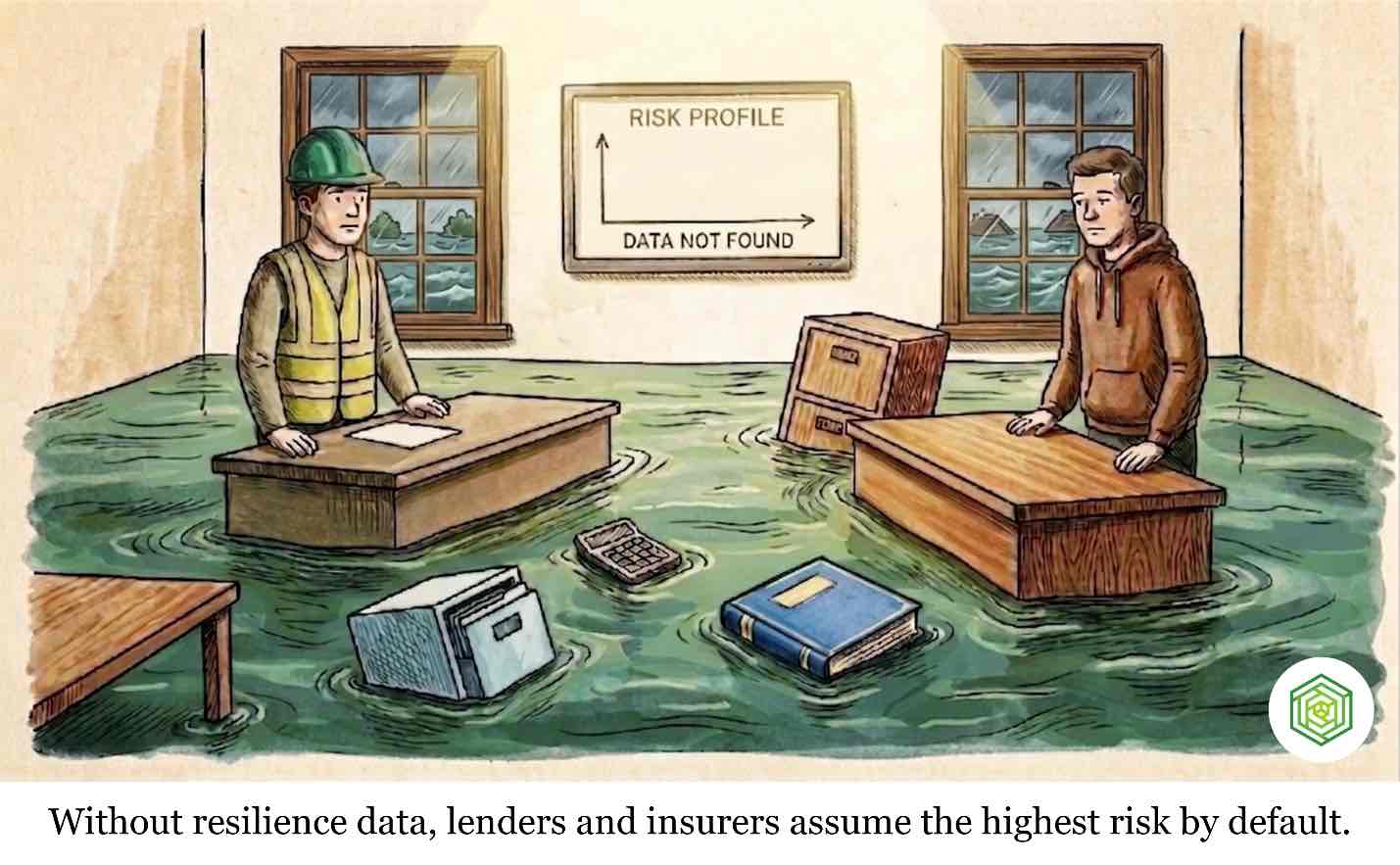
Just as credit history affects your cost of capital, basic climate-risk information and resilience planning now affect how you are priced as a risk. If you have no data, you are treated as a higher-risk unknown by default. You do not need a 200-page sustainability report to change that. You need a short, practical resilience brief that makes two things clear: what you are exposed to, and what you are doing about it. Even the first step — seeing your main climate-related risks clearly enough to fit on one page — can improve how you make decisions about sites, suppliers, equipment, and financing. Turning that view into a simple plan is the next step.
This article explains where climate-related costs actually come from, what insurers, lenders, and large customers are really looking at, and how to think about a Resilience Credit Score for your business. It also introduces the idea of a hidden Default Risk Tax — the extra cost you pay when others have to guess your risk — and sets up the practical steps for building a simple resilience brief that we will cover in the next article.
Where Climate Risk Costs Actually Come From
Climate-related costs rarely arrive in a single line item labeled "climate," "resilience," or "sustainability." They show up through systems that SMBs use every day: insurance, banking, and relationships with large customers. You feel them when renewals come back higher, terms get tighter, or questionnaires get longer — not from a bill called "climate risk."
Insurance: How Underwriters See Your Business
Property and casualty insurers are updating how they think about location and exposure. If the sites and critical suppliers that an SMB depends on are in areas with higher risk of wildfire, flood, storms, extreme heat, or other severe weather, that risk increasingly shows up as:
- Higher base premiums
- Bigger deductibles
- New exclusions for wildfire, flood, or water damage
- Tighter limits on business interruption coverage
- Shorter policy terms and more frequent re-underwriting
The phrase "climate change" is almost never actually found in those documents, but it still shows up in the pricing, deductibles, and exclusions an SMB is offered. From an underwriter's perspective, their job is to decide how likely it is that a future claim will be both large and correlated with other clients. When they do not have much information about your specific situation, they treat an SMB more conservatively by default. "Conservative" in this context means assuming higher potential losses, rounding up rather than down on risk, and building that into the price. That assumption directly increases cost.
Insurance brokers sit in the middle of this process. In many ways, brokers are the defense attorney in the court of underwriting. Their job is to argue that an SMB is a better risk than the default assumptions in the model. But they can only argue with the evidence they have. When a broker submits a renewal without any resilience context, they are effectively sending the underwriter a blank folder and asking them to guess. When they attach a short, credible resilience brief that explains locations, key assets, basic protections, and recent improvements, they are giving the underwriter something concrete to work with.
Banks and Other Lenders: How Credit Terms Are Changing
Lenders care about whether an SMB will be able to repay over the full life of a loan, not just over the next quarter. Climate-related risk shows up in that calculation in several ways. In practice, it often looks like:
- New questions about sector, locations, and key customers
- Interest rates that are higher than those offered to similar businesses that can demonstrate lower risk
- More restrictive covenants around leverage, cash flow, or collateral
- Requests for basic information about climate-related risks and resilience planning
In many cases, these questions come from the same relationship banker an SMB has had for years. The change is not that the banker has suddenly become a climate activist. The change is that their institution's risk models, boards, regulators, and investors are paying closer attention to climate-related stress. Even with legal uncertainty around specific state and federal rules, large banks can see that climate and resilience are material to long-term credit risk and are adjusting their practices — and prices — accordingly.
For an SMB, the effect is similar to insurance. When lenders do not have visibility into your exposure and resilience, you are treated as a higher, less-understood risk. That can mean higher rates, smaller facilities, or tighter covenants than a comparable business that can answer basic questions with a clear brief and a simple plan.
Large Customers: Costs Pushed Down the Value Chain
For SMBs that sell into large enterprises or governments, climate-related expectations often arrive first through customer requirements. They show up in:
- New questions in RFPs about emissions, climate risk, and resilience
- Supplier codes of conduct that require certain practices or disclosures
- Scorecards and preferred-supplier lists that reward vendors with clear data and basic targets
Sometimes the cost is direct. An SMB may need to buy software, commission an assessment, or hire consultants to help answer a questionnaire well enough to stay in a program. Sometimes it is indirect. Teams may spend time, money, and energy pulling data from invoices and spreadsheets to complete yet another custom template.
For many SMBs, the most painful part of this is the time, not just the money. A single 50-page questionnaire from a major customer can easily absorb 40 hours of founder, CFO, or operations lead time. That is a full week that is not spent on sales, hiring, or execution. When every large customer uses a slightly different format, the burden compounds. A simple, reusable resilience brief that answers the core questions once — and can be attached or adapted as needed — is one way to buy that time back.
The Common Thread
Across insurance, banking, and large customers, the pattern is the same. Institutions are under pressure to understand climate-related risk and document how they are managing it. When they look at an SMB with no resilience data and no basic plan, they have to assume more risk than they would for a similar company that can show a clear, concise brief. In practice, "no data" behaves like "no credit history": you are treated as a higher-risk unknown and priced accordingly.
What Insurers, Lenders, and Big Customers Actually Look At
The channels are different, but the questions behind them are not. Whether you are talking to an underwriter, a credit committee, or a large customer's procurement team, most climate-related questionnaires and conversations are trying to get at the same things. The formats vary; the underlying concerns do not.
At a high level, those concerns boil down to four themes: where you are, what you do, how resilient you are today, and whether you have a plan.
The Four Core Questions
When someone on the other side of the table evaluates your business, they are essentially asking:
- Where are your locations and critical assets? Which regions, sites, and facilities matter most, and how exposed are they to wildfire, flood, storms, extreme heat, or other severe weather?
- What industry are you in? What sector are you in, how does your business model work, and how sensitive is it to physical disruption or policy changes?
- How resilient are you today? What physical protections, operational backups, and supplier options do you have in place if something goes wrong?
- Do you understand your risk and have a plan? Have you taken the time to map your key exposures, track a few basic metrics, and outline practical steps you are taking next?
There is no need for expensive, consultant-driven models to answer these questions. Even a one-page resilience brief that lists key sites, critical suppliers and customers, obvious physical risks, past disruptions, and a short list of improvements can move a business out of the "we have no idea" category and into "this company knows its risks."
The Resilience Credit Score and the Default Risk Tax
Every SMB owner understands how credit scores work. If there is no credit history, the business is treated as a higher risk, even if bills are always paid on time. Lenders and insurers assume the worst until proven otherwise. The result is that SMBs without documented resilience pay more, even for the same product and coverage.
Climate risk and resilience are increasingly working the same way. Basic climate-risk information and a simple resilience plan now function like a Resilience Credit Score for a business. When SMBs can answer the four core questions with clear, concrete information, they switch from the "we have no idea" category into an informed risk. An SMB that understands its exposure and uses that knowledge to make better business decisions is already a better risk. If that SMB is also building and executing a plan to mitigate or manage those risks, it becomes even more attractive and is more likely to receive favorable terms.
When a business cannot answer or address its risks at all, it looks like a blank file. In that blank-file scenario, institutions have to protect themselves. Lenders and insurers will assume higher potential losses, add more margin for uncertainty, and build that into the price. That hidden margin is the Default Risk Tax: the extra cost a business pays simply for not knowing — and not showing — its risks and resilience in a way others can trust.
"No data behaves like no credit history: you are treated as a higher-risk unknown and priced accordingly."
In earlier work, we compared the current climate-disclosure system to a dense jungle built for companies with "helicopters" — specialist teams, expensive consultants, and enterprise software. If you want the full version of that analogy, you can read Why Climate Disclosure Is Broken for Small and Mid-Sized Businesses. Those tools are not realistic for most SMBs. What is realistic is answering the four core questions with the data you already have and turning that into a short resilience brief. That brief does not need to be perfect. It needs to be clear enough to show that you know where you are exposed, what you have already done, and where you are going next — enough to start lifting your Resilience Credit Score and to avoid paying the Default Risk Tax by default.
Why Climate Change Is Driving These Costs Up
It does not require a scientific deep dive to understand why climate-related costs keep rising. A few simple trends explain the reality that most SMBs are already seeing in insurance, lending, and customer requirements.
Shifting Baselines and Bigger, Correlated Losses
First, the baseline is changing. Conditions that used to be considered rare — extreme heat waves, once-in-a-century floods, record storms, extended wildfire seasons — are happening more often. When those events hit regions where many businesses, suppliers, and customers are clustered together, losses are not only larger; they are also more connected. Multiple claims arrive at once, infrastructure is strained in several places at the same time, and recovery takes longer across the entire area. Many policyholders are affected at once instead of losses being spread out across locations and time. As a whole, the region becomes a bigger, more volatile risk.
For insurers, that means higher total claims and more volatility in their portfolios. For lenders, it means more concern about whether borrowers can keep operating and generating cash if a cluster of assets or customers is disrupted. The logical response from both is to raise prices where they see more potential for large, correlated losses — and to be cautious when they do not have much visibility into a specific business.
Models, Markets, and Regulators Catching Up
Second, the way risk is measured and governed is catching up to these physical changes. Insurers, banks, and large companies are updating their internal models to treat climate-related risk as a real financial factor rather than a side note. In parallel, boards, investors, and many regulators are asking more questions about how those institutions are measuring and managing that risk, even when specific rules are still evolving or contested.
From an SMB perspective, the details of those models and debates matter less than the practical outcome. Insurance carriers are asking underwriters for more detail on location and resilience. Credit committees are looking for more clarity on how disruption could affect a borrower over the life of a loan. Large customers are adding climate and resilience criteria into how they evaluate suppliers. All of that shows up downstream as more questions and, where there is no information, more conservative pricing.
Why "No Data" Is Getting More Expensive
Put those trends together, and the result is straightforward. The cost of climate-related risk in the system is going up. That is why "no data" is becoming more expensive over time. An SMB that does not know its own risks and cannot show even a basic resilience brief is asking others to fill in the blanks. An SMB that has taken the time to understand its exposure, document it clearly, and outline a simple plan is no longer a blank. Even before any formal disclosure is required, that difference in clarity can be the difference between paying the Default Risk Tax and negotiating from the position of an informed risk.
Where This Leaves SMBs
Climate risk is no longer just an environmental topic that lives in reports and conferences. It is already baked into the meters that matter most to SMBs: insurance premiums, borrowing costs, and the conditions attached to major customers. When insurers, lenders, and procurement teams look at your business, they are increasingly asking a simple question: "How much do we really know about this risk, and how confident are we in that view?"
If you cannot answer that question for yourself, others will answer it for you. In practice, "no data" now behaves a lot like "no credit history." The less visibility underwriters and credit committees have into your locations, operations, and resilience, the more they are pushed toward conservative assumptions. Those assumptions show up as higher prices, tighter terms, and extra time spent proving that you deserve to stay in the relationship at all.
The good news is that the bar to change this story is lower than it appears. You do not need a dedicated climate team or a glossy sustainability report. You need a clear view of a few basics: where your critical sites and relationships are, what kinds of events could disrupt them, what has already gone wrong, and what you are doing about it. Capturing those answers in a short resilience brief turns a blank file into an informed risk — something your broker, banker, and largest customers can work with.
This is consistent with a broader point we made in Why Sustainability Is a Wise Business Decision for SMBs: tending to the "commons" your business depends on — your communities, infrastructure, and natural environment — is not just an environmental gesture. It is part of protecting long-term cash flow, risk, and access to capital.
This article has focused on why the costs are rising and what the people on the other side of the table are actually looking for. It builds on the idea from Why Earth Month Should Be a Business Discipline for SMBs that resilience and sustainability work best when they are treated as year-round business disciplines, not one-off campaigns.
In the next piece, How to Turn Climate Risk Data into Better Insurance and Lending Terms, we will walk through how to build that resilience brief in practice: how to use data you already have, how to turn it into a simple pre-renewal checklist, how to equip your broker to advocate for you, and how tools like Emerald Solutions can help you move from reacting to forms to running a repeatable resilience discipline.
See what Emerald Solutions can do for your business
Generate emissions inventories, climate-risk insights, and ready-to-share reports directly from your QuickBooks data — in minutes, not months.
Request a Demo