Climate change and sustainability are often framed as compliance costs or public relations exercises. For small and mid-sized businesses (SMBs), they are increasingly part of whether the business will grow, compete, and endure.
Understanding and transparently reporting emissions and climate risk has moved beyond a compliance obligation. It has become a direct driver of financial and competitive advantage. Companies that implement thoughtful measurement and disclosure frameworks unlock multiple revenue and cost-management opportunities.
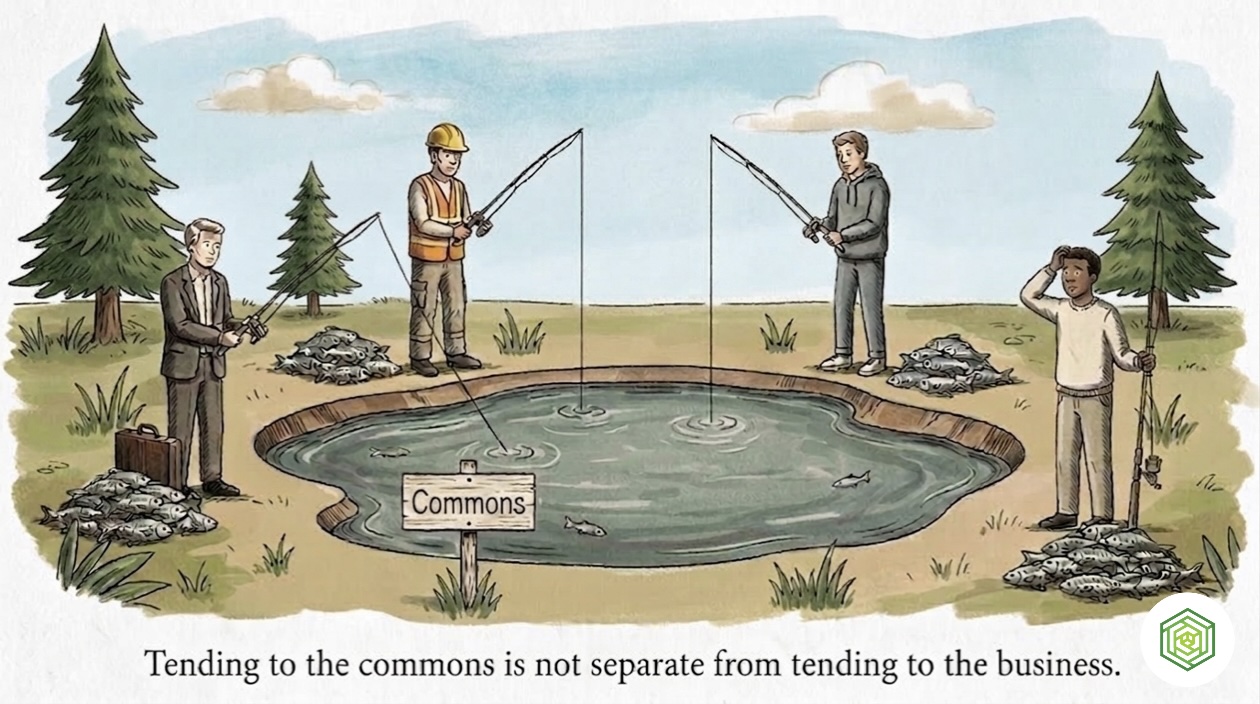
Economists often use the "tragedy of the commons" to describe the damage from prioritizing short-term benefits over long-term viability. In the tragedy of the commons, people overuse a shared resource because they capture the short-term gain while the long-term harm is spread across everyone. Over time, the shared resource is degraded and everyone is worse off.
For SMBs, the "commons" includes the communities, resources, and ecosystems that make it possible to operate at all. Tending to the health of those commons is not a moral bonus; it is part of protecting the long-term value of the business. In other words, it is sustainability.
This article highlights what sustainability is, why it matters for revenue and costs, how customer, regulator, and investor expectations are converging, and how SMBs can approach sustainability as a business discipline rather than a side project.
What Sustainability Is
Sustainability is, in short, business practices with a positive impact. That impact can be on communities, natural resources, or ecosystems, but it must be connected to how the business actually operates.
It is common to hear that companies have a fiduciary obligation to "maximize shareholder value." The actual fiduciary duty is to act in the best interests of the company. In the short term, that often looks like increasing profits. Over time, however, eroding trust with customers, damaging local environments, or ignoring climate-related risks undermines the value of the business itself. That is the tragedy of the commons at the company scale: short-term gain that weakens the shared foundation the business relies on.
Sustainability is one way of describing the set of practices that protect and grow long-term value. Sustainability reduces the risk of damage to credibility with customers, devastation of natural resources, backlash from employees, or degradation of supply chains.
The importance of these practices is growing with each generation of customers. Environmental and social considerations play a smaller role in the purchasing decisions of many Baby Boomers. They play a much greater role for younger generations, especially Gen Z, who are more likely to compare companies based on climate impact and broader sustainability commitments. According to research from PDI Technologies, 77% of Gen Z consumers are willing to pay more for sustainable products and services, compared to 72% of Millennials, 67% of Gen X, and 62% of Baby Boomers — a clear generational ladder.
The trend is clear. The younger the customer, the more likely sustainability is to factor into where they spend their money. Those younger customers will be the "alpha customers" for decades.
Accordingly, fulfilling the fiduciary duty increasingly requires gaining and keeping customers through credible sustainability, not simply through traditional pricing and promotion.
Why Sustainability Is Growing in Importance
Sustainability, like many business functions, has its own terminology and acronyms. It covers a broad set of activities and can be difficult to define precisely.
At the broadest level, "sustainability" encompasses the full set of business practices that affect communities, resources, and ecosystems. One layer down is the term ESG, covering environmental, social, and governance factors. Most of the specific concepts that people use in this space fit somewhere on the Venn diagram formed by those three categories.
For SMBs, it can be helpful to step back from the terminology and ask a simpler question: who is pushing sustainability up the priority list, and why? Three groups highlight why sustainability keeps showing up on SMB agendas: customers and clients, regulators, and investors.
Customers and Clients
For clarity, "customers" are the end purchasers of goods and services, whether retail or business-to-business. "Clients" are organizations that hire a company for professional services or long-term engagements.
Both customers and clients are changing how they evaluate SMBs. Customers increasingly expect to know whether the businesses they support are doing their part on emissions, labor conditions, and community impact. Clients are starting to incorporate sustainability expectations directly into sourcing criteria, supplier questionnaires, and RFP scoring.
When sustainability is credible and clear, it shows up in repeat business, referrals, and win rates. It shows up in a stronger reputation in the community. Sustainability also helps with employee attraction and retention, particularly among younger workers.
In terms of the commons, customers and clients are effectively asking, "Is this company contributing to the health of the commons, or eroding it for short-term gain?" That question now influences real buying decisions.
Regulators
Regulators are also becoming more focused on sustainability. This is not only because voters care, but because the cost of inaction is showing up in public budgets. Extreme weather, fragile supply chains, and environmental degradation all require expensive government responses. These are early warning signs of the tragedy of the commons: shared resources under pressure, and rising costs to manage the fallout.
As those costs rise, regulators respond with new rules on emissions, reporting, worker safety, and supply chain transparency. Some of these rules only apply directly to large companies today. There is also a clear trajectory toward expanding those rules to smaller companies over time.
Even before rules reach SMBs directly, the impacts are already trickling down. New requirements flow through permitting, contracting, and value-chain expectations. These new rules shape how larger customers, lenders, and insurers behave. If a state or region requires large enterprises to disclose emissions and climate risk, those enterprises will in turn expect their suppliers to provide data. Regulators pushing for stronger sustainability will enforce those expectations through larger enterprises, who then pass requirements down the value chain.
For SMBs, the result is a slow but steady rise in sustainability expectations long before most formal rules explicitly include them.
Investors
In this context, "investors" include banks and lenders, venture capital firms, private equity, and other financial institutions. Investors care about sustainability because it affects the bottom line through risk.
Customer sentiment and regulatory changes feed into whether an SMB will be able to generate cash flows, service debt, and grow. On top of this are the climate-related risks, such as extreme weather events, resource scarcity, and degraded supply chains. Investors see higher risk to future earnings, particularly for SMBs, when the commons is under stress.
Unlike most customers and regulators, investors usually think across jurisdictions. When one state or region adopts a higher bar for climate and sustainability disclosure, major investors often treat that bar as the practical minimum across their portfolios. It is easier and safer to require all portfolio companies to meet the strictest standard than to manage different tiers of disclosure.
For SMBs, this shows up as more detailed ESG and climate questions in diligence, term sheets that reference climate-related risk, and loan covenants that expect a basic level of emissions and climate-risk management. SMBs that cannot answer these questions will find it harder to access capital on competitive terms. That difficulty will grow over time.
Taken together, customers, regulators, and investors create a feedback loop. As each group raises its expectations, the others follow. Sustainability becomes less of an optional add-on and more of a prerequisite for staying in the game.
How Sustainability Increases Revenue
Across the sustainability world, a clear pattern keeps showing up. There are projects and practices that would make business sense, even if climate change did not exist. Sustainability work simply highlights them.
Sustainability shows up in revenue in several concrete ways. None of them require a company to become perfect on day one. They do require enough clarity to demonstrate that the business understands its impact and is taking realistic steps to improve.
Supply chain advantage and buyer preference.
Large buyers are increasingly ranking suppliers on emissions and climate risk transparency alongside cost and quality. SMBs that can provide clear, credible data and show a basic plan for improvement gain an advantage in RFPs and contract renewals. Over time, this can translate into higher win rates, larger share of wallet, and more durable relationships.
Enhanced access to institutional capital and equity funding.
SMBs that can explain their emissions profile, climate-related risks, and concrete sustainability actions often find it easier to raise capital. Investors and lenders are more comfortable backing businesses that understand their own exposure and have a plan, even if that plan is modest. For growth-stage SMBs, credible sustainability practices can be part of valuation discussions and investor confidence.
Brand trust, customer preference, and reputational advantage.
Consistent, transparent sustainability practices build trust with customers and communities. That trust becomes an asset when customers choose between similar offerings, when communities decide which employers to support, and when negative events test a company's reputation. SMBs that can back their sustainability claims with data and action are less vulnerable to accusations of "greenwashing."
Patagonia offers a useful illustration of what this looks like in practice. Patagonia's "Worn Wear" program repairs products for free. The initiative required no new product line and no significant capital. But, the result was a brand that customers actively chose, returned to, and recommended. That pattern is repeatable at the SMB level, even without Patagonia's scale.
How Sustainability Reduces Costs
Sustainability is also a cost story. Many of the most effective sustainability projects pay for themselves and then continue to generate savings.
Reduced insurance premiums and risk mitigation.
Insurers are already using climate risk information to adjust pricing. Companies that can demonstrate even basic climate-risk assessments, resilience measures, and emissions reductions may qualify for better terms. Even single-digit percentage differences in premiums can compound into meaningful savings over time.
Lower borrowing costs and preferred credit terms.
Lenders are beginning to factor climate-related risks and emissions into underwriting. Clear disclosure, backed by data, can support better rates, larger credit lines, and more flexible terms compared with otherwise similar SMBs that do not have this information. In a high-rate environment, even small improvements in borrowing costs matter.
Operational optimization and cost reduction.
Sustainability practices often reveal inefficiencies in energy use, transportation, and material waste. Many of the most effective sustainability projects pay for themselves within a few years and then continue to save money.
A concrete example: Benders, a UK paper cup manufacturer, installed new, more sustainable production systems. The energy savings alone produced a payback period of just under six months on a project that cost less than $10,000 to implement. The sustainability benefits and emissions reductions were an added benefit. This kind of project illustrates the core point: it would have been a sensible investment on pure cost grounds regardless of any sustainability benefit.
Research on SMB energy efficiency published in ScienceDirect found that comparable measures can reduce energy costs and greenhouse gas emissions by up to 22%, often with payback periods of three years or less.
Some of the most common examples include efficiency upgrades, route optimization, waste reduction, and reduced packaging. In many cases, these projects would be good decisions even if there were no sustainability benefits at all. Sustainability work simply brings them into focus.
Regulatory pre-compliance and risk avoidance.
As disclosure rules expand, SMBs that have already built basic measurement and reporting capabilities are not forced into rushed, expensive implementations. These SMBs can adapt rather than starting from zero under deadline pressure. That reduces the risk of non-compliance, penalties, and last-minute consulting costs.
Returning to the Commons
At this point it is worth returning to the tragedy of the commons. If every company treats the environment, local communities, and shared infrastructure as someone else's problem, the commons erode. That erosion shows up as higher input costs, fragile supply chains, extreme weather, and community resistance to new projects.
For individual SMBs, ignoring the commons may seem like a short-term savings. In practice, it often means higher costs, lost opportunities, and increased risk in the years that follow. Tending to the commons is not separate from tending to the business. It is part of the same work.
Sustainability provides a way to align these interests. The same practices that protect communities, resources, and ecosystems can also reduce costs, open new revenue streams, and strengthen long-term competitiveness.
How Emerald Solutions Fits In
Emerald Solutions exists because the current climate disclosure system does not work for most SMBs — as described in detail in our earlier piece on why climate disclosure is broken for small and mid-sized businesses. The goal is not to turn SMBs into sustainability departments or to ask them to replicate enterprise-scale programs. The goal is to make it practical for SMBs to understand their impact, manage their risks, and identify the most useful actions.
By using financial and operational data from existing accounting systems, Emerald Solutions generates emissions baselines, climate-risk insights, and decision-ready briefs. Those outputs support the revenue and cost benefits described above — better customer scores, clearer lender conversations, more targeted efficiency projects — without requiring SMBs to become emissions and climate-risk experts.
At a deeper level, the intent is to help SMBs tend to the "commons" they depend on in a way that strengthens both the business and the communities around it. Sustainability is not separate from running the business. Sustainability is part of running the business well.
"The same practices that protect communities, resources, and ecosystems can also reduce costs, open new revenue streams, and strengthen long-term competitiveness."
See what Emerald Solutions can do for your business
Generate emissions inventories, climate-risk insights, and ready-to-share reports directly from your QuickBooks data — in minutes, not months.
Request a Demo