In our last article, Why Climate Risk Is Already on Your Balance Sheet, we looked at how climate risk is already affecting SMBs through higher insurance premiums, tighter lending terms, and more demanding customer requirements. The pattern was clear: insurers, lenders, and large customers are under pressure to understand climate-related risk, and when they do not have information about a specific business, they assume the higher end of the risk range. "No data" behaves a lot like "no credit history" — you pay a Default Risk Tax simply because others have to guess.
The good news is that the bar to change this is much lower than it looks from the outside. You do not need a dedicated climate team or a glossy sustainability report. You need a clear, right-sized way to answer a small set of questions: where your critical sites and relationships are, what they are exposed to, what has gone wrong before, and what you are doing about it. Capturing those answers in a short, practical resilience brief is how you start to raise your Resilience Credit Score and move out of the "blank file" category.
This article walks through how to build that resilience brief using data you already have, how to turn it into a pre-renewal checklist, and how to use it with your broker, banker, and largest customers. It also explains where software that connects directly to your accounting system — such as Emerald Solutions — can help you assemble the underlying data without creating a new manual project.
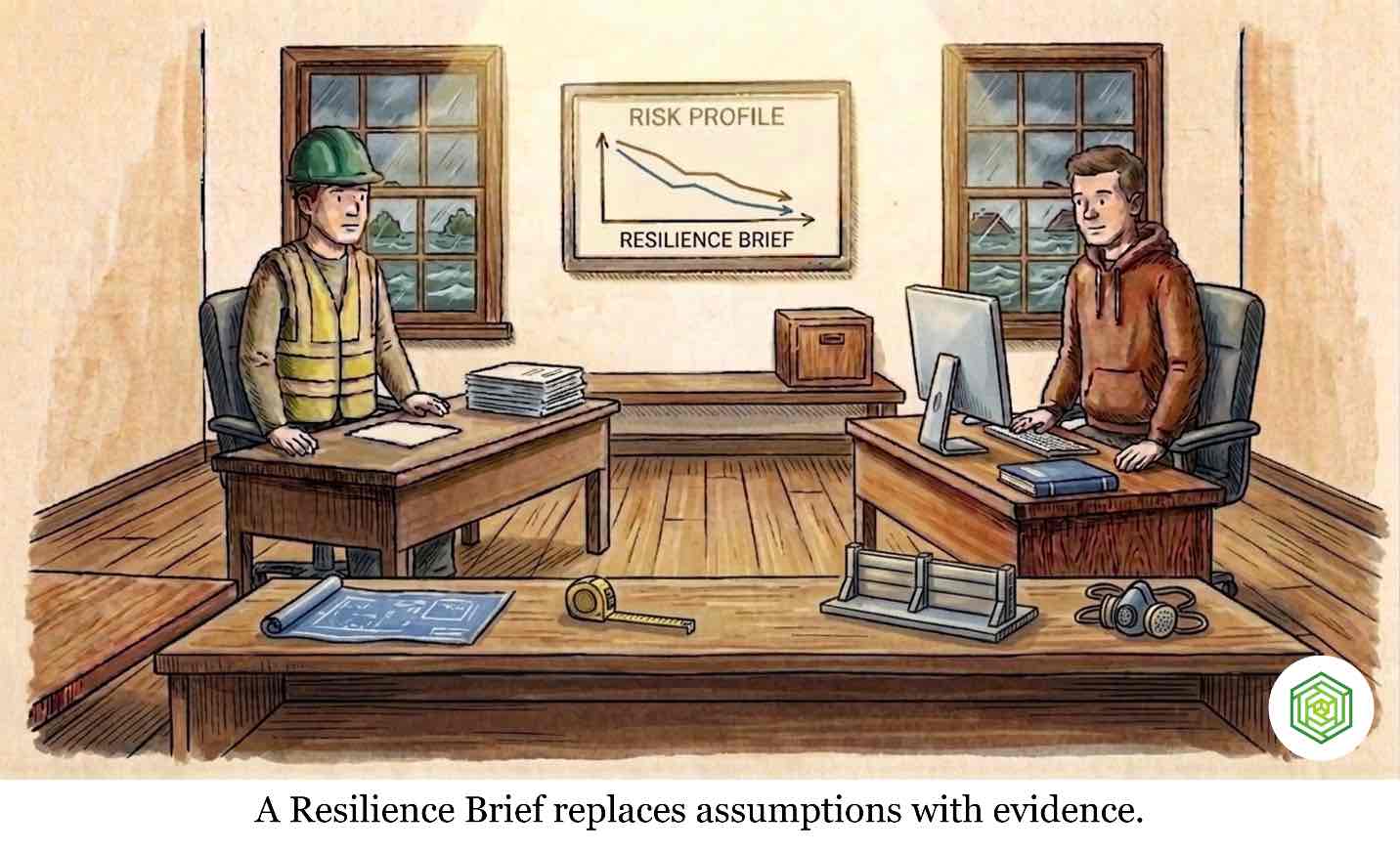
Building a Simple Resilience Brief
The same basic work that makes a business more resilient often makes it easier and cheaper to insure, finance, and stay on critical customer lists. It does not require a glossy sustainability report, a dedicated climate team, or expensive consultant-driven projects. What you need is a simple, documented resilience brief that fits on a page or two and uses data the business already has.
Start with a Short, Practical Resilience View
The first step is to see risks clearly enough that they can inform real decisions. For most SMBs, that can be done with a straightforward resilience brief that covers four areas:
- Critical sites and assets — A list of the locations and facilities that matter most, along with the most obvious physical risks they face: heat, flood, storm, wildfire, smoke, or other local hazards. Focus on the sites that drive most of your revenue or operations, not every address you have ever used.
- Critical suppliers and customers — The vendors and customers the business depends on most, and where a disruption would hurt revenue, operations, or reputation the fastest. This does not have to be a full supply-chain map; it is the short list of relationships you cannot afford to lose easily.
- Recent disruptions and near misses — A short record of events the business has already experienced — storms, smoke days, outages, shipping delays — and what those disruptions cost in time, money, and lost opportunities. This shows you are paying attention to real-world signals, not just hypothetical scenarios.
This does not have to be perfect. The goal is to move from the "we have no idea" category to "we can see on one page which sites and relationships are most exposed." Even that level of clarity makes it easier to decide where to invest, which contracts to renegotiate, and what questions to ask brokers and lenders.
Identify a Small Set of Actions That Genuinely Reduce Risk
Once there is a basic view of risks, the next step is to pick a few straightforward resilience actions. These usually fall into three buckets:
- Physical measures — Upgrading sump pumps or drainage in a flood-exposed warehouse, clearing brush and adding defensible space around a facility in a wildfire zone, adding shade or cooling for critical equipment in a region seeing more extreme heat, or moving inventory and key equipment out of basements and other high-risk areas.
- Operational measures — Adding a second supplier for a critical input instead of relying on a single source, adjusting stocking levels ahead of peak fire or storm seasons, updating backup power and communication plans for your most important sites, or rethinking where new equipment, offices, or warehouses are located based on emerging risks.
- Process measures — Updating emergency procedures so people know what to do and who decides, rehearsing basic response steps once or twice a year, and making sure the right people know where key information lives — contact lists, vendor details, and access instructions for critical systems.
Insurers and lenders are not looking for perfection. They respond to specific, plausible actions that match the business's scale and risk profile. A short list of concrete steps you have actually taken will often do more for your risk profile than a long, aspirational list that never moves off the page.
Connect Resilience, Cost, and Decision-Making
The point of this work is not to win an award for best resilience plan. It is to run the business in ways that reduce both risk and cost over time. The goal is to be able to:
- Show a clear understanding of your main climate-relevant risks
- Explain a few specific changes that reduce the chance and impact of disruption
- Point to a short list of next steps that are realistic for the business's size and budget
Even before you share anything externally, seeing this information clearly changes internal decisions. It can influence which lease is renewed, which supplier is added, which projects are delayed, and where limited capital is invested. That internal shift — to knowing the risks and acting on them — is what turns a static snapshot into a true resilience brief, and it is what starts to lift your Resilience Credit Score over time.
Using Your Accounting Data to Build the Brief
You can build a resilience brief manually with spreadsheets and interviews. For many SMBs, though, the fastest path is to start from the systems that already know the business best: accounting and finance tools. They quietly capture much of what insurers, lenders, and large customers are trying to understand.
What Your Accounting System Already Knows
Your existing accounting platform typically holds three of the four pillars of a resilience brief:
- Critical suppliers and customers — Who you pay the most by vendor, who pays you the most by customer or client, and which relationships drive the bulk of your cost of goods sold and revenue
- Where climate-relevant costs sit — Energy spend across locations or accounts, logistics and shipping costs, and other categories that would be affected by disruption or extreme conditions
- Basic location and entity structure — Which legal entities, branches, or cost centers exist, and in many cases enough addressing information to map those entities to regions and associated climate hazards
On top of this, your team knows the pieces the system does not: what has actually gone wrong in the past (disruptions and near misses), and which resilience actions you have already taken or plan to take.
How Software Can Assemble the Backbone of the Brief
Instead of starting from a blank document, software that connects directly to your accounting system can do several things automatically:
- Surface critical relationships — Identify which suppliers and customers are most material based on spend and revenue patterns, and flag concentration risks such as a large share of revenue tied to a single customer
- Map locations to climate hazards — Use the locations associated with your entities or key vendors to highlight relevant climate hazards (flood risk in one region, wildfire risk in another) and translate those external hazard indicators into plain-language observations you can include in your brief
- Highlight where climate-relevant costs are concentrated — Show which sites or activities drive most of your energy, logistics, and other relevant operating costs, and give you a starting point for deciding where resilience actions would have the most impact
A platform like Emerald Solutions is designed to do exactly this: connect to existing accounting data, combine it with location and industry context, and generate decision-ready outputs. Instead of asking you to build a resilience brief from scratch, it pre-populates the backbone — critical suppliers and customers, key locations and hazards, major cost drivers — and can also generate a solutions brief that highlights high-impact actions to consider next. It moves SMBs from a blank page to a structured, data-backed starting point.
Keeping Human Judgment in the Loop
Even with good software support, human judgment is still essential. The system can suggest which suppliers and customers are "critical," but you know which relationships are truly strategic. The system can flag that a site is in a flood-exposed region, but you know what protections are already in place. The system cannot automatically know that you cleared brush around a facility or moved inventory to higher ground — you add those details.
The point is not to automate judgment. It is to automate the parts that are tedious and repetitive — pulling data, ranking relationships, mapping locations — so that your time goes into describing what has happened and what you plan to do next. When you combine that human context with the data you already produce, you get a resilience brief that is both grounded and practical, without turning it into a separate full-time job.
A Pre-Renewal Resilience Checklist You Can Actually Use
Before your next insurance renewal, loan negotiation, or major contract with a large customer, it helps to pause and make sure the basics of your resilience brief are in place. The goal is not to produce a thick policy binder. It is to walk into those conversations as an informed risk, rather than waiting to see what price shows up in your inbox.
A Short Checklist Before You Sign
A practical pre-renewal checklist can fit on a single page. Each item maps directly to a section of your resilience brief:
- Sites and assets — Do we have a current list of our key sites and assets, with any obvious physical risks noted for each location?
- Recent disruptions — Can we describe at least one or two recent events — storms, smoke, outages, shipping issues — and what they cost us in time, money, and lost opportunities?
- Basic data — Can we show, even at a simple level, where our major energy, water, and logistics costs are, and which sites or activities drive most of that spend?
- Actions taken — Can we name two or three concrete steps we have taken in the last 12–24 months that reduce operational or climate-related risk?
- Next steps — Do we have a short list of planned improvements, prioritized by impact and feasibility, rather than a vague wish list?
- Ownership — Is it clear who is responsible for climate-related risk and resilience decisions across finance, operations, and leadership?
If you can answer "yes" to most of these questions, your resilience brief is already in good shape. If not, the "no" answers become your to-do list before the next renewal cycle or major contract.
Turning the Checklist into a Shareable Brief
The most useful version of this checklist is not a set of internal notes; it is a short document you can share. When you pull these answers together into a simple resilience brief — one that describes your key exposures, recent disruptions, actions taken, and next steps — you have something you can hand to a broker, banker, or key customer.
That one-pager is the external face of your resilience work. Internally, the checklist keeps you honest and gives you a rhythm for updates. Externally, the brief functions as a practical summary of your Resilience Credit Score. It shows that you know where you are exposed, what you are doing about it, and how you plan to improve. Instead of arriving at renewals or negotiations as a blank file, you arrive as an informed risk with a clear, documented framework.
"Instead of arriving at renewals as a blank file, you arrive as an informed risk with a clear, documented framework."
Broker's Corner: Giving Your Defense Attorney Evidence
For most SMBs, the primary point of contact with the insurance market is not the carrier; it is the commercial broker. That broker can either show up as an order taker who passes forms back and forth, or as a risk architect who helps you present the strongest possible case to underwriters. The difference often comes down to whether they have real evidence to work with.
For Commercial Brokers
If you are a commercial broker, you know that "as-expiring" renewals are becoming harder to defend. Sending the same basic application each year and hoping for a flat outcome is no longer realistic in many regions and sectors. When you submit a standard application without any resilience context, you are essentially asking the underwriter to guess the risk.
A short resilience brief changes that conversation. When you can attach a clear, concise document that describes an SMB's key locations and assets, obvious physical risks, recent disruptions, and concrete resilience actions, you are giving the underwriter a reason to move that account out of the default bucket. Instead of relying only on the model and a few high-level fields, they can point to specific protections and improvements when they make a pricing decision.
This is what it looks like to move from order taker to risk architect. You are still submitting the same core forms, but you are adding a narrative that helps underwriters see why this business should be treated as an informed, managed risk rather than an unknown.
For SMB Owners Working with Brokers
If you are an SMB owner or finance leader, your broker is your defense attorney in the court of underwriting — but they can only argue the case you equip them to make. There are two practical steps you can take before your next renewal:
- Do not wait for your broker to ask for resilience data. Share your resilience brief with them early in the renewal process, or even when you first approach a new broker. That brief should cover your key sites, major risks, recent disruptions, actions taken, and next steps.
- Ask a specific question about how risk is priced. A simple prompt: "What data points are the underwriters using to price my catastrophe exposure, and how can I provide evidence to lower that risk profile?" This invites your broker to explain what matters most and where better information could help.
Sending a clear resilience brief with your initial application signals to underwriters that you are an informed risk, not a blank file. It gives your broker something concrete to work with, and it moves the conversation from "here is the price we were given" to "here is why this business deserves better terms."
From One-Off Questionnaires to a Resilience Discipline
When you put these pieces together — a concise resilience brief, a simple pre-renewal checklist, and a broker who has real evidence to work with — you move from reacting to individual questionnaires to running a basic resilience discipline. Instead of scrambling each time a carrier, lender, or major customer asks for more information, you start from a standing view of your risks and actions, and you update it as the business changes.
Tools that connect directly to your accounting system, like Emerald Solutions, are there to reduce the friction in this process, not to replace your judgment. They help you see which suppliers and customers are truly critical, how your locations map to climate hazards, and where climate-relevant costs are concentrated — so you can focus your time on deciding what to do about it. Over time, that combination — clear data, a practical brief, and a repeatable checklist — raises your Resilience Credit Score, reduces the Default Risk Tax you pay by default, and makes resilience part of how you run the business, not just how you fill out forms.
If you would like a simple resilience brief template and checklist you can adapt for your business, we are happy to share one. Reach out through our site or sign up for updates from Emerald Solutions, and we will send you a version you can customize for your next renewal cycle.
Get your resilience brief template
We'll send you a simple, one-page resilience brief template and pre-renewal checklist you can adapt for your business — no strings attached.
Request the Template