Every April, Earth Day and Earth Month show back up on business calendars, in inboxes, and on people's social feeds. For many small and mid-sized businesses (SMBs), they show up as one more campaign to manage: a themed newsletter, a volunteer day, a green logo, or a short post about climate and community. Then the month of May arrives, and day-to-day business takes back over again.
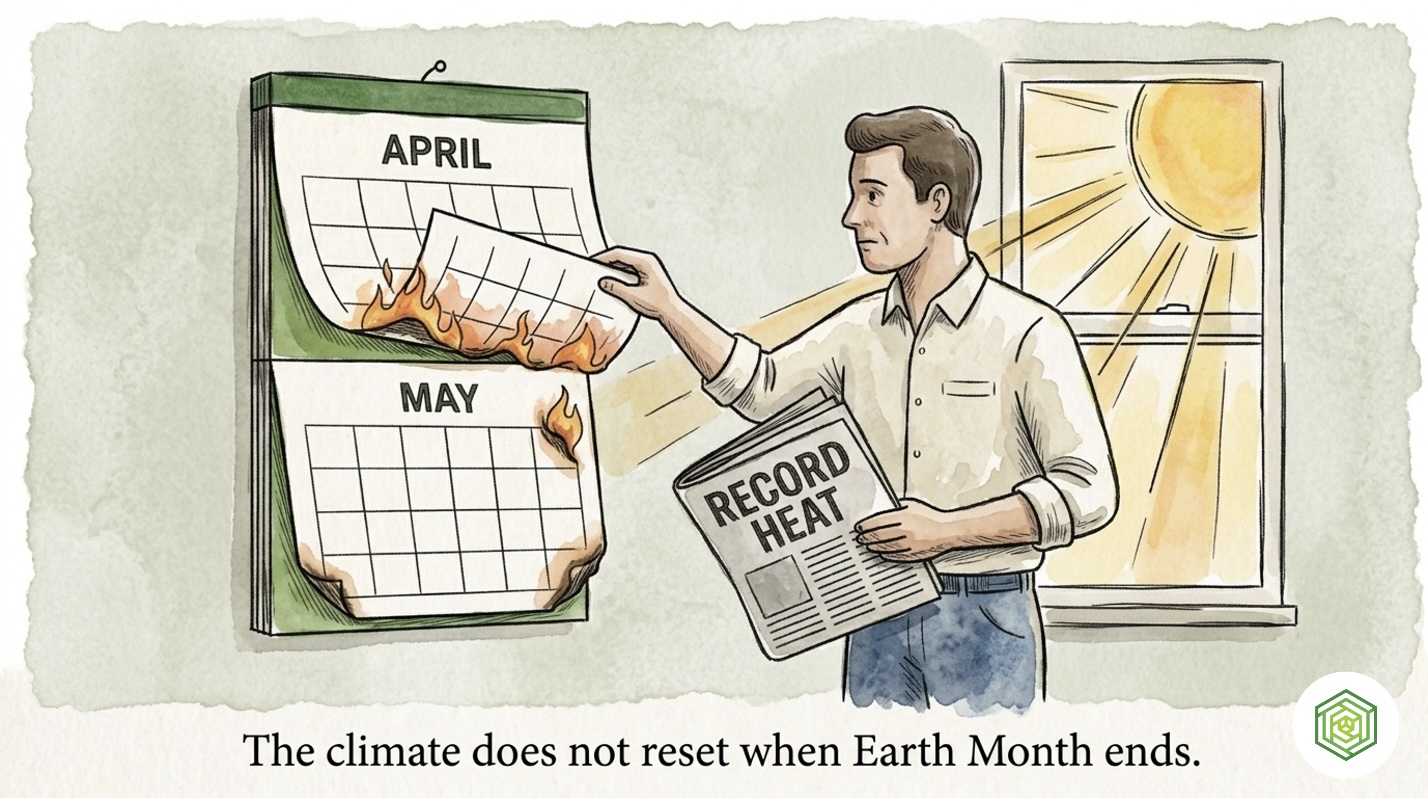
However, the climate does not reset when Earth Month ends. Heat, storms, insurance costs, and customer expectations continue to grow throughout the year. The calendar keeps flipping, and the notes on it increasingly look the same: "record heat," "another billion-dollar disaster," "premiums up again." At some point, it becomes reasonable to ask whether Earth Month should remain a once-a-year event, or whether it should become a business discipline.
This article highlights where Earth Month came from, what it means in practice for businesses today, how the underlying climate and cost trends are evolving, and what it would look like for SMBs to treat Earth Month as a business discipline rather than a marketing theme. It also describes how Emerald Solutions can help SMBs make that shift using data and systems they already have.
A Brief History of Earth Day and Earth Month
Earth Day began on April 22, 1970, as a nationwide "teachin" on the environment led by Senator Gaylord Nelson. It brought together an estimated 20 million Americans, roughly 10 percent of the U.S. population at the time. The focus was to educate people on polluted air, toxic rivers, and degraded ecosystems. The scale of that participation was unusual. So were the results.
The public attention that Earth Day created led to the eventual creation of the U.S. Environmental Protection Agency (EPA) and major environmental statutes such as the Clean Air Act and the Clean Water Act. Over time, Earth Day spread globally and expanded into Earth Week and later Earth Month. Schools, community groups, and companies used April as a focal point for environmental education and activities. Today, more than a billion people worldwide take part in some form of Earth Day or Earth Month activities each year.
This history matters because Earth Day was about changing systems, not just raising awareness. It focused on shifting rules, incentives, and operations to reduce harm and improve long-term outcomes. The question for SMBs today is whether Earth Month is serving that role inside their businesses, or whether it has drifted toward awareness without corresponding change.
What Earth Month Has Come to Mean for Businesses
In many organizations, Earth Month follows a familiar pattern. There may be an employee volunteer event, a tree-planting day, or a donation drive. Communications teams prepare a series of sustainability-themed posts. Some companies host internal talks on climate or environmental topics, run short "go green" challenges, or temporarily refresh branding elements to include more green imagery.
These efforts are not wrong. They can build community, demonstrate values, and create moments of pride. But, for many SMBs, Earth Month can feel like an extra burden on an already long list of things to do. There are real time and budget constraints. And, Earth Month rarely changes how the business operates the rest of the year. The projects that determine energy use, logistics patterns, supplier choices, and resilience to extreme weather are not affected.
In that sense, Earth Month has become very effective at raising awareness about sustainability, but less effective at actually making business more sustainable and resilient. The original spirit of Earth Day was focused on institutional change. It has become overshadowed by marketing and one-off events. For SMBs already navigating a complex disclosure "jungle," as described in our earlier piece on why climate disclosure is broken for small and mid-sized businesses, it can be difficult to see how Earth Month connects to immediate business decisions.
The Climate and Cost Signals Behind Earth Month
Regardless of how companies choose to mark Earth Month, the physical and financial context is changing. Global average temperatures continue to rise, contributing to more frequent and severe heatwaves, floods, storms, droughts, and other extreme weather events. These are not distant projections; they are conditions that increasingly affect operations, supply chains, and local communities.
The economic impacts are already material. In the United States alone, weather-related disasters in 2025 caused an estimated $115 billion dollars in damage. It was one of the most expensive years on record for weather-related damage costs. These costs show up as property damage, business interruption, infrastructure repairs, and increased premiums. These costs are projected to rise as climate impacts continue to worsen.
SMBs feel climate-related costs more. World Bank analysis shows that revenue for SMBs declines around 12% in years that are just 0.5°C hotter than historical averages. Climate Hub data found that most SMBs lack the time, funding, and specialist skills to do more to address these costs.
These trends do not arrive neatly packaged in April. They accumulate over the year. They influence insurance renewals, loan terms, supplier reliability, and customer expectations. In our piece on why sustainability is a wise business decision for SMBs, we described this as part of the "commons" SMBs depend on — the communities, resources, and systems that make it possible to operate at all. The erosion of that commons shows up as higher costs and higher volatility, whether a company has a formal Earth Month program or not.
From Earth Month Campaigns to Year-Round Practice
For SMBs, the practical question is not whether to observe Earth Month. The question is how to use Earth Month in a way that supports the business throughout the entire year. Earth Month should be a checkpoint and celebration of a year's worth of planned activities that make the business more successful, resilient, and sustainable.
In practice, that can look like:
- Using Earth Month to take stock of how climate risk and sustainability show up in the business, not in abstract terms, but in energy bills, logistics, supplier relationships, and customer requirements.
- Reviewing whether existing data systems, especially accounting and operational systems, can surface enough information to understand emissions and climate-sensitive activities at a level that is appropriate for the company's size and risk profile.
- Identifying a small set of projects that would make sense on both cost and climate grounds, such as targeted efficiency upgrades, route or inventory optimization, or supplier changes that reduce both risk and emissions.
This is consistent with the themes in our piece on why climate disclosure is broken for small and mid-sized businesses and our piece on why sustainability is a wise business decision for SMBs. In the first article, we noted that the current disclosure "jungle" was built around large enterprises with "helicopters" — consultants, specialized staff, and expensive software. Asking SMBs to follow the same route, with the same level of precision, does not make sense. In the second, we described how sustainability becomes a wise business decision when it increases revenue, reduces costs, and protects the commons the business depends on.
Earth Month can serve as the moment when SMBs align these two perspectives. Rather than treating April as a one-off campaign, SMBs can use it to confirm that their approach to emissions and climate risk is sized correctly for their business and is oriented toward decisions and actions, not just disclosure for its own sake. The goal is not perfection. The goal is a repeatable, right-sized rhythm: measure enough to act, act on what matters most, and improve over time.
"Earth Month should be the annual reminder to check that the direction is still right, the data are still useful, and the actions still make sense."
How Emerald Solutions Fits Into Earth Month
Emerald Solutions is designed to help SMBs turn Earth Month from a campaign into a business discipline, without asking them to build new systems from scratch or hire a team of specialists.
Emerald Solutions starts with data SMBs already maintain, particularly in accounting and operational systems. It converts that information into emissions inventories and climate-risk insights that are aligned with recognized frameworks but calibrated for smaller organizations. Those measurements can then support the full set of audiences discussed in our climate disclosure article: formal disclosures where required, customer-facing reports when requested, and internal briefs for owners, boards, and lenders.
The emphasis, however, is on what happens after measurement. Emerald Solutions highlights practical options for becoming more sustainable and more resilient, prioritized by impact and feasibility, so that SMBs can direct time and budget toward projects that matter for both cost and climate. That is the bridge back to our sustainability article: using sustainability to strengthen revenue, manage costs, and protect the commons.
Viewed this way, "celebrating Earth Month every month" is not a slogan. It is shorthand for running the business in a way that acknowledges that climate and sustainability are now part of core operations, not just communications. Earth Month becomes the annual reminder to check that the direction is still right, the data are still useful, and the actions still make sense. The work itself continues across the calendar — to move away from reporting and marketing to becoming more resilient and sustainable.
See what Emerald Solutions can do for your business
Generate emissions inventories, climate-risk insights, and ready-to-share reports directly from your QuickBooks data — in minutes, not months.
Request a Demo