In How to Build a Simple Carbon Ledger, we showed how financial data already in your accounting system can become a simple carbon ledger: a clean, consistent record of how your business activities translate into emissions.
At the same time, the questions around that ledger are multiplying. Customers are adding climate sections to RFPs. Lenders are asking for emissions and climate risk disclosures alongside financial statements. Insurers want to know how climate change could affect your operations before they price your policy. For most small and mid-sized businesses, those requests do not arrive as one big "sustainability program" or "climate request." They show up as a pile of disconnected asks sitting on top of everything else. It does not feel like a sustainability opportunity. It feels like a data jungle.
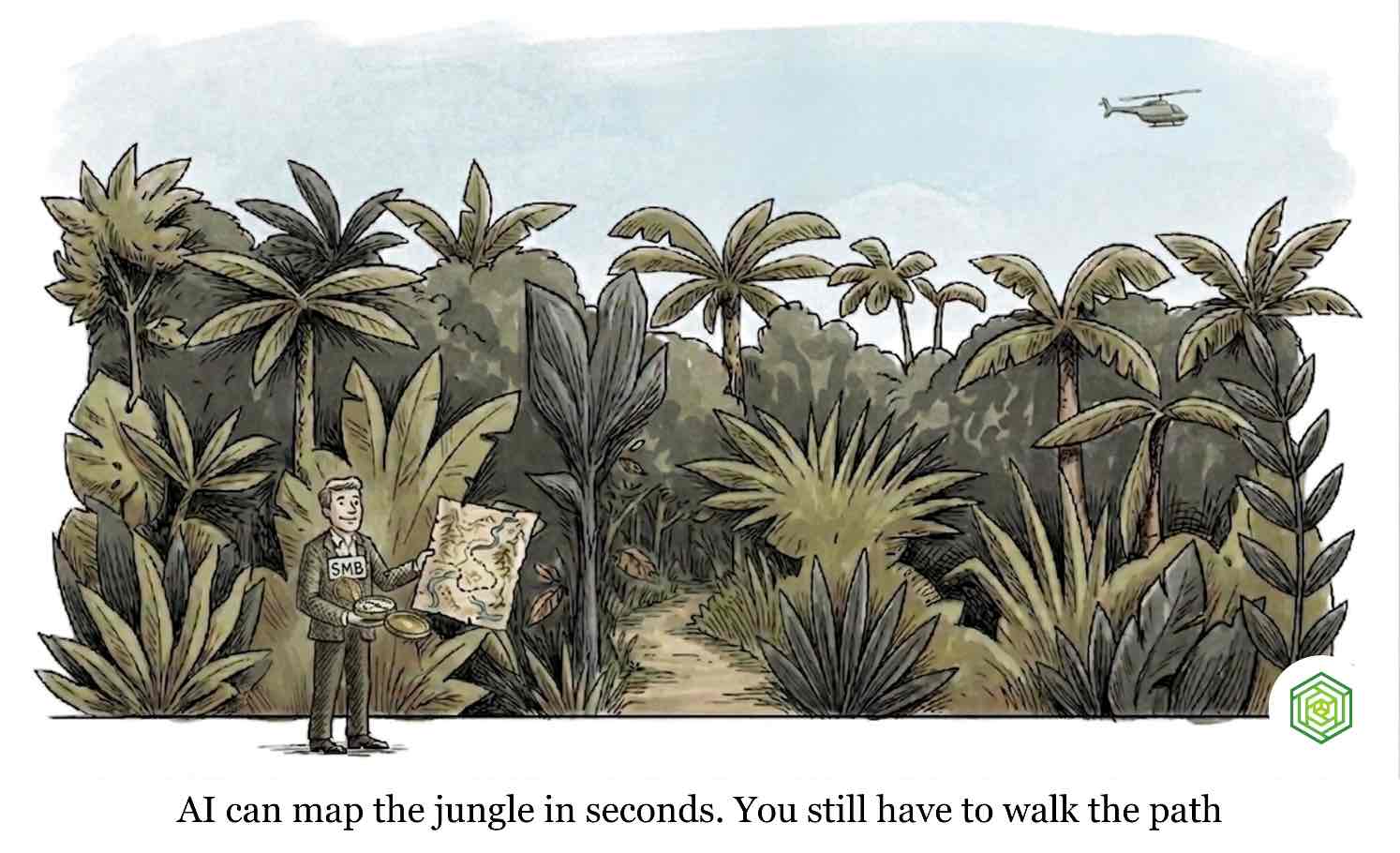
AI can map that jungle in seconds. You still have to walk the path. This article walks through what "mapping the jungle" looks like in practice. It shows how an AI-native platform can take the carbon ledger you already have, turn it into emissions and climate risk briefs, surface ranked next steps, and still leave the real business decisions — what to do, when to do it, and how fast to move — firmly in your hands.
Why AI Matters for SMB Sustainability Work
For most small and mid-sized businesses, sustainability and climate work feels out of reach for reasons that have little to do with the underlying concepts. The basics are understandable: emissions, climate risk, physical hazards, transition risk. What makes it hard is the volume and variety of what is needed to build a useful answer.
An average SMB would need to pull thousands of financial transactions and map them into dozens of potential emissions categories. Those categories then have to be aligned with recognized frameworks and linked to emissions factors drawn from government and peer-reviewed datasets. On top of that, the company's locations need to be tied to decades of climate data: temperature trends, precipitation shifts, wildfire history, land cover change, and more.
Its industry needs to be benchmarked against sector-specific vulnerability research across several climate scenarios. Only then can all of that be translated into something a leadership team, lender, customer, or insurer can actually read and act on.
At a large enterprise with a sustainability team, that workflow becomes a project plan — the kind of multi-month effort we described in Why Climate Disclosure Is Broken for Small and Mid-Sized Businesses. It might take months and involve climate scientists, data engineers, and external consultants. For most SMBs, the same task has historically been out of reach. That is why the default answer to many climate questions has been "we don't track this yet." Not because the business does not care, but because there was no realistic path to a complete and credible answer.
This is exactly the kind of pattern AI is well suited to help with. The pieces that are hardest for an SMB are the ones that require volume, consistency, and patience: categorizing data, applying emissions factors, pulling climate datasets, running scenarios, and turning technical outputs into plain language. Those are also the pieces AI can now do at scale, in the background, and at a speed that fundamentally changes who can access this level of analysis.
Consider what used to be required to assess climate risk for a specific location and industry. Someone had to source satellite datasets, select emissions pathways, run simulations across thousands of possible futures, and then convert those results into a risk picture connected to operations, revenue, and insurance. Or consider what it took to turn a year of financial transactions into an audit-ready emissions inventory across all three scopes, accompanied by a narrative that explains where the hot spots are and why they matter. In practice, both of those were consulting engagements. They happened slowly, and only when someone was willing to budget for them.
AI can compress both of those paths from months to minutes. It does not make the climate science simpler, and it does not remove the need for judgment. What it does is handle the high-volume, high-consistency work — data mapping, simulation, and translation — in a way that makes this level of emissions and climate analysis realistic for a trucking company, a regional manufacturer, or a mid-sized distributor, not just a Fortune 500 balance sheet.
That shift matters because the questions showing up in inboxes and RFP portals do not scale with team size. Customer questionnaires ask for Scope 1, 2, and 3 emissions whether an SMB has a sustainability department or not. Insurance renewals ask for climate risk disclosures whether or not anyone has ever run a scenario. Lenders ask for emissions intensity numbers whether or not the term is familiar. The gap between those asks and what most SMBs have had access to is precisely the gap AI-native tools are meant to close. In other words, the jungle was never just new concepts. It was the sheer volume of data and analysis required to give a confident answer.
A vendor who leaves climate sections blank looks like future friction.
Later in this article, we will walk through what comes out the other side when that kind of AI is pointed at a simple carbon ledger: emissions baselines, climate risk metrics, ranked action lists, internal briefs, and external reports. Before we get there, it is worth pausing on one question that determines whether any of those outputs will actually be useful to you or to the people reading them: whether they can trust how the AI arrived at its answers.
Which AI Approaches Are Worth Trusting
Not all AI is equally useful for sustainability and climate work. For a small or mid-sized business, the most trustworthy tools usually share three traits. They show where the underlying data came from. They make it possible to understand how the output was built. And they leave the final business judgment with management, not the software.
That matters because the real value of AI in this domain is not that it can produce an answer quickly. It is that it can produce an answer that someone else can understand and use. If a lender asks where an emissions number came from, or a customer asks how a climate risk conclusion was reached, there should be a clear path back to the underlying inputs, assumptions, and methods. A result that cannot be explained may still be fast, but it is not very useful in a real business setting.
A useful way to think about it is this: AI should be trusted to do the heavy processing and first-pass translation. It should not be trusted to replace management judgment. In practice, that means AI can help build the emissions inventory, summarize the climate risk picture, and surface likely next steps. People still need to decide whether a recommendation is affordable, material, realistic, or worth acting on now versus later.
The least useful version of AI in this space is the kind that gives a company a score, rating, or recommendation without making the logic visible. If the tool cannot explain what data it used, what assumptions shaped the result, or how the output connects back to the business itself, it creates another layer of confusion instead of solving one. In sustainability work, that kind of opacity is a liability.
The more useful version is AI that shows its work. It starts with clear inputs such as financial transactions, business locations, and industry information. It relies on identifiable methods, datasets, and frameworks. Then it turns the results into language that leadership teams, customers, lenders, insurers, and auditors can actually follow. The goal is not just speed. The goal is an output that can stand up to questions.
Good tools are also clear about their limits. Estimated emissions are not the same as direct measurement. Modeled risk is not the same as a guarantee of what will happen. A tool can support disclosure preparation without replacing legal, accounting, or audit advice. In sustainability and climate work, that kind of transparency is not a weakness. It is part of what makes the output credible.
That is the filter that matters here: use AI that shows its inputs, explains its outputs, and keeps decision-making where it belongs.
AI should handle the volume and first-pass translation. Management still owns the judgment.
How to Use AI Well in Sustainability Work
Once you know what kind of AI is worth trusting, the next step is using it in a way that actually makes sustainability work easier, not heavier. The goal is to turn climate questions into something manageable, not to give yourself a new project to manage.
Principle 1: Aim AI at the Volume
The best use of AI in this space is to handle the high-volume work that slows everything down. That includes tasks like categorizing transactions, pulling data from different systems, applying emissions factors, and checking calculations. These are the parts that tend to stall progress when they live in spreadsheets and email threads. Let AI handle the repetitive parsing and math so people can spend time on decisions instead of data prep.
Principle 2: Separate "Understanding" from "Sharing"
It helps to draw a clear line between internal understanding and external communication. Internal understanding is what leadership and finance teams need to feel confident in the numbers: concise explanations of emissions, climate risks, and possible actions in language they use every day. External communication is what leaves the building: responses to customer questionnaires, lender packages, and public sustainability reports.
AI is well suited to create internal explanations first. That is where odd results can be questioned, where context can be added, and where the business can decide what is actually material. Only after that review should those insights flow into anything that goes to customers, lenders, or insurers.
Principle 3: Let AI Simplify the Work, Not Complicate It
AI outputs should make sustainability work feel more approachable, not more intimidating. Draft emissions narratives, risk summaries, or short lists of potential actions should reduce the blank-page problem. The test is simple: after reading an AI-generated explanation, does the average small or mid-sized business leader feel like they have a clearer picture and a smaller set of choices to think about?
If the answer is yes, the AI is doing its job. A team can then adjust details, add their own examples, and decide which points matter most for their situation. The technology has taken care of the heavy lifting and structure. People are refining the story, not building it from scratch.
Principle 4: Think in Reusable Building Blocks
Sustainability questions may show up in different forms: an RFP, an insurance renewal, a lender questionnaire. The underlying information needs are similar. Emissions baselines, climate risk insights, and prioritized actions are building blocks that can be reused across many of those requests.
AI is most helpful when it makes those building blocks easy to refresh and reuse. Instead of treating every new request as a separate project, the business can lean on a consistent set of summaries and metrics that stay current in the background. When a new question arrives, the work is to select and tailor what already exists, not to start from scratch.
How Emerald Solutions Clears the Path
The ideas so far have been broad: why AI matters for SMB climate work, what kind of AI is worth trusting, and how to use it well. Emerald Solutions is built around that pattern. It takes the financial data already sitting in an SMB's accounting system and turns it into something much more usable: an emissions baseline, a climate risk picture, a short list of practical actions, and clear reports for the people asking questions.
Step 1: Emerald Solutions Turns Accounting Data into an Emissions Baseline
Emerald Solutions begins with the company's accounting data. It connects to the underlying financial records for the selected year and maps those transactions into the three core emissions categories used in greenhouse gas reporting: Scope 1, Scope 2, and Scope 3. Scope 1 covers direct emissions from sources the business owns or controls. Scope 2 covers indirect emissions from purchased electricity and energy. Scope 3 covers other indirect emissions across the value chain, such as purchased goods and employee commuting.
Emerald Solutions works directly inside your accounting system. It does not see or retain your underlying financial records, and it never keeps a separate copy of your books. That means you are not creating a new financial data-storage risk or inviting another party to review your ledgers just to answer climate questions. All calculations run against your accounting data where it already lives, and the only outputs Emerald Solutions returns are the environmental metrics and narratives.
That process produces more than a single footprint number. It creates a structured emissions baseline with totals by scope, intensity metrics, and the categories driving the result. Then the Emissions Brief explains what those numbers mean in plain language. Instead of a raw table, the business gets a shared understanding of its emissions baseline. The software handles the mapping and math. Leadership decides what deserves attention.
Step 2: Emerald Solutions Connects That Baseline to Climate Risk
Once the emissions baseline is in place, Emerald Solutions adds the other half of the picture: climate risk. It uses the company's location and industry to build a view of how physical and transition risks may affect the business over time. That includes not just modeled risk metrics, but also visual analysis that helps make the issue easier to see.
This is where the maps matter. Emerald Solutions uses visual tools to show land surface temperature trends, wildfire history, forest loss, land cover change, evapotranspiration, and other climate-related conditions around the business. Those maps help translate climate data into something far more concrete than an abstract score. A business can actually see how the physical environment around its location is changing, and how those shifts connect to questions about resilience, operations, insurance, and planning. The Climate Risk Brief then ties those visuals and metrics back to the business in plain language.
Step 3: Emerald Solutions Narrows the Field to Practical Actions
After emissions and climate risk are visible, the next question is what to do next. Emerald Solutions answers that through its Solutions Marketplace. Rather than forcing an SMB to sort through a long list of disconnected sustainability projects, it ranks practical actions by cost savings, sustainability impact, and customer connection.
That matters because SMBs are often offered sustainability ideas in one of two unhelpful forms: generic lists with no real prioritization, or expensive consulting-style recommendations that are high on effort and cost but weak on practical business value. Emerald Solutions is built to cut through that. It surfaces the actions most likely to make sense for the business based on its industry, location, and emissions profile. The result is a shorter, clearer set of next steps. Management still decides what is affordable, realistic, and worth doing now versus later. In a trucking example, that might mean:
- Testing EVs for final-mile routes
- Optimizing routes and loads before investing in new assets
- Using available public incentives to improve payback periods
But the business is no longer standing in front of a blank page.
Step 4: Emerald Solutions Turns the Work into Reports and Disclosures
The final step is turning the analysis into something the business can actually use and share. Emerald Solutions takes the same underlying emissions, climate risk, and solution analysis and builds it into internal briefs, sustainability reports, and disclosure-ready outputs. Those materials can support conversations with customers, lenders, insurers, and regulators.
This matters because most of these requests are variations on the same underlying questions. An RFP, an insurance renewal, a lender questionnaire, and a state disclosure requirement may all ask for similar information in slightly different forms. Emerald Solutions helps the business build that information once, then reuse it in ways that are easier to update and easier to tailor.
This is also where trust has to hold. Emerald Solutions is designed to be clear about what the platform does and does not do. It helps map financial activity to emissions factors, generate climate risk analysis, and produce structured reports. It does not replace management judgment, legal advice, or third-party assurance. And it is built so the customer does not have to create a new data-retention problem just to answer climate questions. That kind of boundary matters as much as the output itself.
Taken together, these four steps are what it looks like when the jungle finally has a path through it. Emerald Solutions does not pretend the terrain disappears. Climate questions still need answers. Tradeoffs still need decisions. But instead of asking an SMB to cut through dense undergrowth with spreadsheets, consultants, and scattered requests, Emerald Solutions maps the terrain, marks the key turns, and leaves the actual steps to you.
AI can map the jungle in seconds. You still have to walk the path.
Where to Go from Here
For most SMBs, the real barrier was never understanding that emissions, climate risk, and sustainability mattered. The barrier was getting from scattered accounting data and disconnected climate questions to something clear enough to use. That was the jungle.
AI does not remove the terrain. Customers will still ask for emissions data. Lenders will still ask about climate risk. Insurers will still want a clearer picture of exposure. What AI can do, when it is built the right way, is map that terrain faster, more clearly, and at a cost that makes sense for a normal business.
That is the shift Emerald Solutions is built around. It starts with the accounting data already in place. It turns that into an emissions baseline, a climate risk picture, a short list of practical actions, and reports that can support conversations with customers, lenders, insurers, and regulators. It does the heavy processing and translation work. The business still decides which path to take.
For an SMB, that path does not need to start with a grand sustainability strategy. It can start much smaller and much more practically. Build the carbon ledger, as we described in How to Build a Simple Carbon Ledger. Use it to generate an emissions baseline. Add climate risk. Then use those building blocks to answer the next customer questionnaire, lender request, or insurance renewal with something better than "we do not track this yet."
That is what makes this moment different from the one described in Why Climate Disclosure Is Broken for Small and Mid-Sized Businesses. The problem has not gone away. But for the first time, the path through it is becoming realistic for SMBs without a Fortune 500 budget, a climate consulting team, or months of manual work.
The next article will stay with that same path and look more closely at the chain of outputs: what an SMB actually gets when accounting data meets a sustainability platform, from the first emissions baseline to the reports and disclosures that can travel outside the business.
See what Emerald Solutions can do for your business
Generate emissions inventories, climate-risk insights, and ready-to-share reports directly from your QuickBooks data — in minutes, not months.
Request a Demo