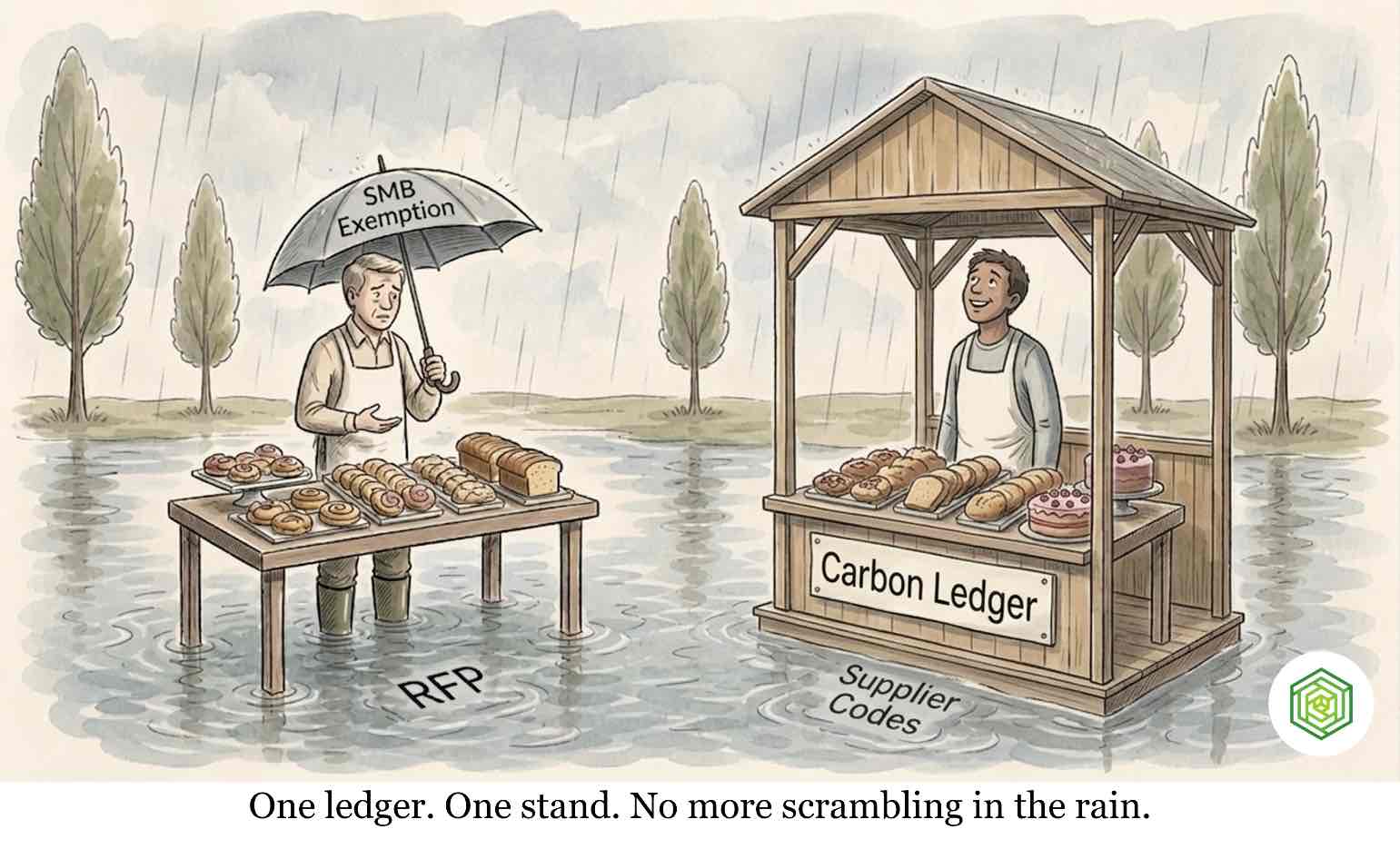
In How Climate Rules Reach SMBs, Even When They're Exempt, we left two small bakeries standing in the rain under umbrellas labeled "SMB Exemption," water pooling around their boots as climate rules and big-customer net-zero goals came down around them. One bakery kept shifting the umbrella and hoping the storm would pass. This article is about the other one, the baker who decided to build something better.
On paper, many SMBs are still exempt from the main climate disclosure rules. In practice, that exemption does not stop the questions arriving through their largest customers. As those customers are pushed to measure and manage emissions across their entire value chain, their suppliers feel it first in RFPs, supplier codes of conduct, vendor portals, and "quick" emissions templates. The result is recurring rounds of ad-hoc spreadsheet work and a familiar answer that lands worse every year: "We do not track this yet."
If climate questions are going to reach you either way, the leverage is not in waiting for the questions to stop. It is in how you answer. The baker who built a stand did not change the weather; they changed how prepared they were to stand in it. In the same way, a simple carbon ledger gives an SMB a stable way to turn the data they already have — spend, energy use, travel — into a small set of emissions numbers and explanations they can reuse every time a customer asks.
This article walks through what that kind of carbon ledger looks like for an SMB, why the data you already track in your accounting system is the natural starting point, and how turning it into a reusable "emissions snapshot" can shift the way procurement teams see you — from future friction to ready partner — without turning you into a mini Fortune 500.
What a simple SMB carbon ledger looks like
When people hear "carbon accounting," they often imagine a Fortune-500-style project: consultants, expensive software, and a reporting process no one inside the business actually understands. For most SMBs, that picture is not just unhelpful — it is a reason to put the whole topic off. A useful carbon ledger for an SMB looks very different.
At its core, a carbon ledger is simply a way to count the greenhouse gases your business is responsible for in one common unit. Greenhouse gases trap heat the way a blanket traps warmth, and carbon dioxide equivalent (CO2e) is the standard way of expressing different gases in a single metric. Most carbon ledgers then organize emissions into three buckets: Scope 1, the fuel you burn directly; Scope 2, the electricity you buy; and Scope 3, everything else in your value chain that would not happen if not for your business.
There are several greenhouse gases, not just carbon dioxide. Rather than tracking each one separately, most systems convert them into a single unit: carbon dioxide equivalent, or CO2e. That means methane, nitrous oxide, and other gases are all expressed as the amount of CO2 that would trap the same amount of heat. CO2e gives you one common metric so very different activities can be added up and compared.
From there, most emissions reporting is organized into three "scopes":
- Scope 1: Direct emissions from sources you own or control, such as fuel burned in your boilers, furnaces, or company vehicles.
- Scope 2: Indirect emissions from the electricity you buy and use.
- Scope 3: Everything else in your value chain that would not happen if not for you — purchased goods and services, freight and shipping, business travel, use and disposal of what you sell, and so on.
Inside that structure, the goal for an SMB carbon ledger is simple: describe emissions for a clearly defined slice of your business over a clearly defined period. In practice, that ledger produces four things:
- Total emissions for the year, in CO2e
- How that total splits across Scope 1, Scope 2, and aggregate Scope 3
- A short, plain-language description of your boundary and method
- A short list of concrete steps you have taken or plan to take to reduce emissions over time
If you can keep those elements consistent from year to year and from customer to customer, you are already ahead of most peers.
Think of it less like buying a room full of gym equipment and more like choosing one tracker and a plan. You can spend time and money collecting every possible metric, or you can pick a simple, reliable way to measure what matters and stick with it. A carbon ledger for an SMB is that one tracker and plan: a deliberately scoped way to turn what you already do into a small set of numbers and explanations you can actually maintain.
Start from the data you already have: accounting as the backbone
Once you know what you are trying to describe, the next question is where the numbers come from. For most SMBs, the answer is not a new system or a separate emissions database. It is the system you already trust to run the business: your accounting system.
Every major activity that drives emissions shows up in your accounting system as spend. Your utility bills, fuel purchases, materials and packaging, freight and shipping, business travel, contractors and outside services — they are all already captured as transactions. That is the real starting point for a simple carbon ledger: not a blank form, but the record of what you have already done and paid for over the year.
A spend-based emission factor is just a way of translating those dollars into estimated CO2e. For each type of spend, there is an estimated amount of emissions per dollar based on how that category typically behaves — how much CO2e is usually associated with a dollar of grid electricity, a dollar of freight, or a dollar of hotel and air travel. When you multiply what you spent in that category by the factor, you get a reasonable estimate of the emissions for that slice of your business.
What that looks like in practice is straightforward: a carbon-ledger engine takes a year of accounting data, groups transactions into a small set of emissions-relevant categories, and applies spend-based emission factors to each of those categories. The result is a consistent set of CO2e estimates that line up with the way you already see your business: where the money goes, and what it pays for.
That is the assumption Emerald Solutions is built on. Most SMBs do not need a cabinet full of new measurement tools or a helicopter over the disclosure jungle. They need a way to turn the financial data they already trust — the data in their accounting system — into a simple carbon ledger and an emissions snapshot they can keep current without hiring a climate team or learning a new language. Your carbon ledger starts where your business already keeps score.
"You are not trying to guess every molecule; you are trying to build a stable, explainable method you can use every time a customer asks a climate question."
Turn your ledger into a reusable answer set
A carbon ledger is most useful when it stops being a one-time project and becomes a standing answer bank. The same emissions snapshot that helps you understand your own footprint can also transform how you respond every time a customer asks a climate question.
On the customer side, the goal is simple: make it easy for your largest buyers to use your numbers in their own emissions reporting. A short, standard "emissions snapshot," built directly from your accounting-based ledger, can travel with you into RFPs, supplier portals, and annual reviews. Instead of hunting for numbers every time a new form appears, you attach the same 1–2 page summary, describe the same boundary and method, and answer the same core questions in the same way.
That consistency does more than save time. It changes how you look from the other side of the table. Procurement and sustainability teams are trying to decide which suppliers will be straightforward to bring along and which ones will require extra work. A vendor who leaves climate sections blank looks like future friction. A vendor who hands over a clear snapshot and a stable method looks like a partner who is ready to be part of their story, not a risk they have to manage.
Because your ledger is built from accounting data, it also lines up emissions hotspots with spend hotspots. The categories that drive the biggest emissions often drive significant cost: utilities, freight, and materials or packaging. Over time, that makes your emissions snapshot a useful lens for spotting efficiency opportunities that reduce both emissions and operating costs, and for seeing where you might want to get ahead of likely future asks from regulators or other customers.
Once you have a simple, accounting-based carbon ledger and a reusable snapshot, you are no longer rewriting your story for each new template. You are pulling from the same set of numbers and explanations every time, which is exactly what changes how procurement teams see you.
Procurement Corner: from ad-hoc answers to a competitive edge
Most SMBs are still doing ad-hoc archaeology every time an emissions questionnaire shows up: digging through invoices, portals, and old emails to reconstruct the past under deadline. A consistent carbon ledger changes that math entirely.
Without a ledger, every RFP or portal feels like a new project. The questions change slightly each time, the spreadsheets never look the same, and the answers drift from customer to customer because they are being assembled under pressure. "We do not track this yet" or rough one-off estimates feel honest in the moment, but leave buyers guessing how much extra work you will create for them down the line.
With a ledger in place, the experience looks very different. The next RFP does not require a fresh round of digging; you are pulling from the same emissions snapshot and the same small answer bank you already use elsewhere. The totals match, the scope breakdown matches, and the one-paragraph method description matches. When a portal or questionnaire appears, you are filling in fields from a system you control, not reinventing your story to fit someone else's spreadsheet.
From the procurement side of the table, that difference is not abstract. Buyers are under pressure to meet their own climate targets and disclosure obligations without slowing down the business. When they see a supplier who can respond quickly, cleanly, and consistently on emissions, that supplier looks safer to introduce to their internal stakeholders and easier to keep as a preferred vendor. When they see a supplier who leaves climate sections blank or provides improvised answers, that supplier looks like future friction.
Early supplier programs and third-party evaluations are already pointing in the same direction: vendors who can provide clear, credible emissions data tend to score higher in ESG-weighted reviews and see meaningful, double-digit improvements in win rates and order volumes compared to peers who cannot. The exact numbers will vary by program and industry, but the pattern is consistent. Being ready on emissions is no longer just about avoiding a problem; it is increasingly a way to tilt close calls in your favor.
Seen through that lens, a simple, accounting-based carbon ledger is not only an answer to recurring forms. It is part of how you present yourself as a prime-ready partner: the supplier who shows up with numbers in order, method explained, and a clear signal that you will not become a disclosure headache two years from now.
"A vendor who leaves climate sections blank looks like future friction."
From scrambling in the rain to building a simple stand
In How Climate Rules Reach SMBs, Even When They're Exempt, both bakers were standing in the same storm. Each one had an umbrella labeled "SMB Exemption," and the water was still pooling around their boots as climate rules and big-customer net-zero goals came down. One bakery kept adjusting the umbrella and hoping the questions would slow down. The other built something sturdier.
A simple, accounting-based carbon ledger is that sturdier structure. It does not stop the rain of RFPs, supplier codes, and questionnaires. It gives you a covered stand and a small shelf where your emissions snapshot sits next to the bread. When the next questionnaire arrives, you are not scrambling in the downpour. You are reaching for a set of numbers and explanations you already trust.
Once you have built the first version of that system, it stops being a special project and becomes part of an annual rhythm. Your accounting data updates automatically as the year rolls on. Your boundary and method stay the same. Refreshing your emissions snapshot becomes a scheduled task — pull the latest year of data, run it through the same approach, and update the one or two-page summary — rather than a crisis you tackle from scratch.
Instead of trying to stay out of sight until the next form appears, you decide how you will count, you base it on the data you already track in your accounting system, and you turn the result into a standing answer bank you can use on your own terms. Emerald Solutions makes that simple for SMBs by turning accounting data into a carbon ledger and reusable emissions snapshot, so the next climate question is one more place you can say, "Here is how we count," instead of "We do not track this yet."
If you have not read the earlier pieces in this series, you can find them in the Emerald Solutions Learning Center.
See what Emerald Solutions can do for your business
Generate emissions inventories, climate-risk insights, and ready-to-share reports directly from your QuickBooks data — in minutes, not months.
Request a Demo